
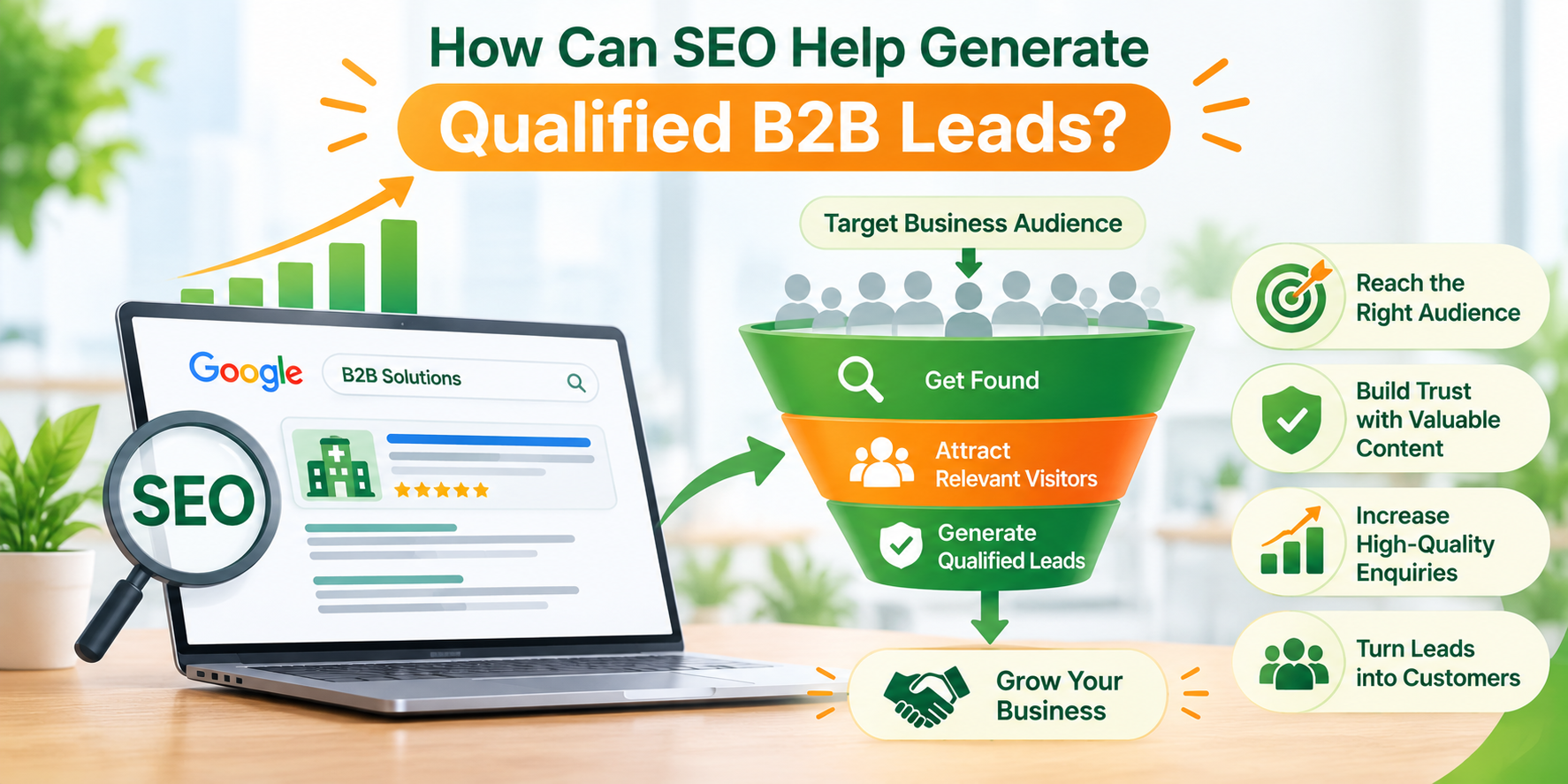
Generating qualified business leads is one of the biggest challenges for B2B companies. Reaching the right audience, building trust with potential buyers, and turning website visitors into genuine business enquiries requires more than traditional marketing. Businesses need a strategy that connects their products and services with people who are actively searching for solutions.
This is where B2B SEO (Business-to-Business Search Engine Optimization) becomes valuable. It helps businesses improve their online visibility, reach relevant decision-makers, attract high-intent website visitors, and create opportunities for meaningful business relationships. Instead of focusing only on increasing website traffic, an effective B2B SEO strategy targets search queries that indicate genuine interest in a product or service.
By combining keyword research, search intent optimization, helpful content, technical SEO, and conversion-focused landing pages, businesses can build a sustainable organic lead generation channel.
What Is B2B SEO and Why Does It Matter for Lead Generation?
B2B SEO is the process of optimizing a business website to improve its visibility in search engines and attract potential customers from other businesses. Unlike B2C SEO, which often targets individual consumers and shorter purchase journeys, B2B SEO focuses on business buyers, procurement teams, managers, and decision-makers who may require detailed information before making a purchasing decision.
For example, a manufacturing company searching for an industrial packaging supplier may compare multiple providers, review service capabilities, evaluate product specifications, and request quotations before selecting a partner. Businesses looking for professional SEO support can compare top B2B SEO agencies in Mumbai to understand different approaches to improving organic visibility and generating business leads.
A well-planned B2B SEO strategy helps businesses become visible throughout this research process.
B2B SEO supports lead generation by:
- Connecting businesses with relevant search audiences.
- Attracting potential customers through industry-specific keywords.
- Building credibility through informative and authoritative content.
- Supporting buyers during different stages of their decision-making journey.
- Encouraging qualified visitors to request consultations, demonstrations, and quotations.
The goal is not simply to generate more traffic but to attract visitors who are more likely to become potential business customers.
8 Ways SEO Helps Generate Qualified B2B Leads
1. Targets High-Intent B2B Keywords
Keyword research is an important part of B2B SEO because it helps businesses understand what potential customers are searching for.
Not every search query represents the same level of buying interest. Some users are researching general information, while others are actively comparing providers or looking for specific services.
For example:
Targeting a combination of these keywords allows businesses to reach potential buyers at different stages of their purchasing journey.
An effective keyword strategy should focus on commercial search intent, industry-specific terms, long-tail keywords, and service-related searches that attract relevant business enquiries.
2. Reaches Business Decision-Makers
B2B purchasing decisions often involve multiple stakeholders, including business owners, procurement managers, department heads, and technical professionals.
SEO helps businesses create content that addresses the specific questions and requirements of these audiences.
For example, a software development company can create dedicated landing pages and informative resources around enterprise software development, custom CRM solutions, and business automation services.
By targeting relevant industry searches, businesses can improve their chances of reaching people who influence or make purchasing decisions.
3. Builds Trust Through Valuable Content
Trust is particularly important in B2B transactions because business buyers often evaluate service providers before entering into a commercial relationship.
Publishing useful, accurate, and experience-based content helps demonstrate industry knowledge and expertise.
Businesses can develop different content formats, including:
- Detailed service and solution pages.
- Industry-specific guides and educational blogs.
- Case studies and project examples.
- Customer success stories and testimonials.
- Frequently asked questions.
- Comparison articles and buying guides.
Following Google’s E-E-A-T principles (Experience, Expertise, Authoritativeness, and Trustworthiness) helps businesses demonstrate the reliability and credibility of their information.
Content should reflect genuine industry knowledge rather than simply repeating commonly available information.
4. Optimizes Landing Pages for Business Enquiries
Attracting relevant visitors is only one part of lead generation. Businesses also need to make it easy for potential customers to take the next step.
SEO-friendly landing pages should clearly communicate what a company offers, who it serves, and how its solutions address customer requirements.
Important landing page elements include:
- Clear service descriptions and value propositions.
- Relevant industry-specific keywords.
- Detailed information about products or services.
- Client testimonials and trust signals.
- Relevant case studies or project examples.
- Clear calls to action (CTAs).
- Simple enquiry and contact forms.
For example, a B2B service provider can include options such as “Request a Quote,” “Schedule a Consultation,” or “Discuss Your Project” to encourage meaningful enquiries.
A well-optimized landing page connects search visibility with conversion opportunities.
5. Attracts Leads Through Long-Tail Keywords
Long-tail keywords are specific search phrases that often reveal a user’s particular needs or requirements.
For B2B businesses, these searches can be valuable because buyers frequently look for specialized products, services, and solutions.
For example:
| General keyword | Long-tail keyword |
|---|---|
| IT services | Managed IT services for small manufacturing companies |
| Packaging solutions | Custom industrial packaging solutions for export businesses |
Creating relevant content around these specific searches helps businesses reach more targeted audiences.
It also provides an opportunity to address detailed customer requirements and attract visitors with stronger commercial intent.
6. Strengthens Local and Industry-Specific Visibility
Many B2B companies serve customers within particular cities, regions, or industries. Local SEO and industry-focused optimization can help these businesses reach relevant audiences.
For example, an industrial equipment supplier serving Mumbai, Pune, and Ahmedabad can create relevant location and service pages to improve its visibility for geographically specific searches.
Businesses can strengthen local search visibility through:
- Google Business Profile optimization, where applicable.
- Accurate business contact information.
- Location-specific service pages.
- Relevant local business listings.
- Customer reviews and testimonials.
- Consistent business information across online platforms.
This approach is particularly useful for manufacturers, consultants, logistics providers, IT companies, and professional service businesses targeting specific markets.
7. Improves Visibility Across AI-Powered Search Platforms
The way people discover businesses is evolving. Alongside traditional search engines, potential buyers increasingly use AI-powered platforms to research companies, compare solutions, and understand complex business requirements.
Platforms such as ChatGPT, Google AI Overviews, Gemini, and Perplexity provide new opportunities for businesses to improve their online discovery.
B2B companies can improve their AI search visibility by following effective B2B website optimization practices that make their content more accessible and relevant across AI-powered platforms.
- Publishing accurate and informative business content.
- Answering industry-specific questions clearly.
- Building topical authority around their services.
- Maintaining consistent brand and business information.
- Implementing relevant structured data.
- Earning credible mentions and references across relevant websites.
AI search optimization and Generative Engine Optimization (GEO) complement traditional SEO by helping businesses make their information more accessible, understandable, and useful across evolving search experiences.
However, visibility in AI-generated responses depends on multiple factors and cannot be guaranteed through optimization alone.
8. Supports Long-Term Organic Lead Generation
Paid advertising can provide immediate visibility, but businesses generally need to continue investing to maintain that traffic.
SEO takes a longer-term approach by improving website structure, content quality, authority, and organic search visibility.
As relevant pages become more visible for targeted search queries, they can continue attracting potential customers over time.
A sustainable B2B SEO strategy includes regular keyword research, content updates, technical improvements, performance monitoring, and conversion optimization.
Although SEO requires consistent effort, it can become an important long-term channel for attracting relevant business opportunities.
How to Build an Effective B2B SEO Strategy
Generating qualified leads requires a structured approach rather than optimizing individual pages without a clear objective.
Here are some important steps businesses should consider:
Understand Your Ideal Customer Profile (ICP)
Identify the types of businesses you want to attract, including their industries, company sizes, locations, requirements, and purchasing responsibilities.
Understanding your ideal customer profile helps create more relevant keyword and content strategies.
Map Keywords to the Buyer Journey
Organize keywords according to different stages of the purchasing journey:
- Awareness: Informational searches and industry-related questions.
- Consideration: Solution comparisons, service research, and provider evaluations.
- Decision: Pricing, quotations, consultations, and service provider searches.
This ensures that your website supports potential buyers from initial research to final enquiry.
Create Dedicated Service and Industry Pages
Avoid using one general service page to target multiple unrelated audiences.
Instead, develop relevant landing pages that explain how your solutions address specific industry requirements.
For example, an IT company can create separate pages for cloud computing, cybersecurity, managed IT services, and enterprise software development.
Measure SEO and Lead Generation Performance
Track performance using tools such as Google Analytics 4 and Google Search Console.
Important metrics include:
- Organic traffic from relevant search queries.
- Keyword visibility and search impressions.
- Organic enquiry and form submission volume.
- Conversion rate of organic landing pages.
- Qualified lead volume.
- Lead-to-customer conversion rate.
Connecting SEO performance with actual business enquiries helps identify which pages and strategies contribute to meaningful business growth.
Common B2B SEO Mistakes That Affect Lead Quality
Even businesses receiving organic traffic may struggle to generate qualified enquiries when their SEO strategy lacks proper targeting.
Some common mistakes include:
- Targeting broad keywords: Attracting visitors who are not relevant to the company’s services.
- Ignoring search intent: Creating content that does not match what potential buyers actually need.
- Using generic service pages: Failing to communicate industry expertise and specific solutions.
- Neglecting conversion optimization: Making it difficult for visitors to contact the business.
- Publishing low-value content: Prioritizing content quantity over usefulness and accuracy.
- Ignoring technical SEO: Overlooking website speed, mobile usability, indexing, and crawlability.
- Measuring traffic alone: Focusing on visitor numbers without evaluating lead quality.
Addressing these issues helps businesses build a more focused SEO strategy that supports genuine business opportunities.
Conclusion
SEO can play an important role in generating qualified B2B leads by connecting businesses with potential buyers who are actively searching for relevant products, services, and solutions.
From targeting high-intent keywords and optimizing service pages to building industry authority and improving AI search visibility, every part of a well-planned B2B SEO strategy contributes to better online discovery.
However, successful lead generation requires more than higher search rankings or increased website traffic. Businesses need relevant content, clear messaging, a technically sound website, and effective conversion pathways.
With a consistent and data-driven SEO approach, B2B companies can strengthen their organic visibility, build trust with decision-makers, and create sustainable opportunities for business growth.
Frequently Asked Questions (FAQs)
1. What is B2B SEO?
B2B SEO is the process of optimizing a business website to improve organic search visibility and attract potential customers from other businesses. It involves keyword research, technical SEO, content optimization, and strategies designed to reach business decision-makers.
2. How does SEO help generate qualified B2B leads?
SEO helps generate qualified B2B leads by targeting relevant search queries, attracting high-intent visitors, and providing useful information that supports purchasing decisions. Optimized service pages and clear enquiry options help turn relevant website visitors into potential business leads.
3. What are the best SEO strategies for B2B lead generation?
Effective strategies include commercial keyword targeting, search intent optimization, industry-specific content creation, technical SEO, landing page optimization, internal linking, and conversion rate optimization.
4. How long does B2B SEO take to generate leads?
B2B SEO generally takes several months to show meaningful improvements, although timelines vary depending on website authority, competition, industry, technical condition, and content quality. Lead generation also depends on the relevance of the targeted keywords and landing pages.
5. What is the difference between B2B SEO and B2C SEO?
B2B SEO focuses on attracting businesses, professionals, and decision-makers, often involving longer purchasing cycles and multiple stakeholders. B2C SEO generally targets individual consumers and may involve shorter buying journeys and more immediate purchasing decisions.
6. Which keywords should B2B companies target?
B2B companies should target a combination of industry-specific, service-related, commercial-intent, and long-tail keywords. The right keyword selection depends on their target audience, business offerings, industry, and customer search behaviour.
7. Can small B2B businesses compete with larger companies through SEO?
Yes. Small B2B businesses can build organic visibility by focusing on specialized services, niche industries, location-specific searches, and long-tail keywords. Publishing valuable content and demonstrating genuine expertise can help them reach relevant audiences.
8. How can I measure the success of a B2B SEO campaign?
Businesses can measure B2B SEO performance through organic traffic, keyword visibility, qualified enquiries, landing page conversions, lead quality, and customer acquisition. Google Analytics 4 and Google Search Console are useful tools for monitoring different aspects of performance.
9. Is content marketing important for B2B SEO?
Yes. Content marketing helps B2B companies answer buyer questions, demonstrate industry expertise, explain complex solutions, and build trust. Blogs, case studies, service pages, and industry guides can support organic visibility and lead generation.
10. How does AI SEO help B2B businesses generate leads?
AI SEO helps B2B businesses improve the accessibility and relevance of their information across AI-powered search experiences. Clear answers, authoritative content, structured data, and consistent brand information can improve opportunities for discovery when potential buyers research business solutions through AI platforms.