Search behaviour is changing. Instead of typing a few keywords into Google and choosing from a list of blue links, users are increasingly asking AI systems complete questions such as, “Which SEO agency can help my business improve its Google visibility?” or “What are the best healthcare marketing companies in Mumbai?”
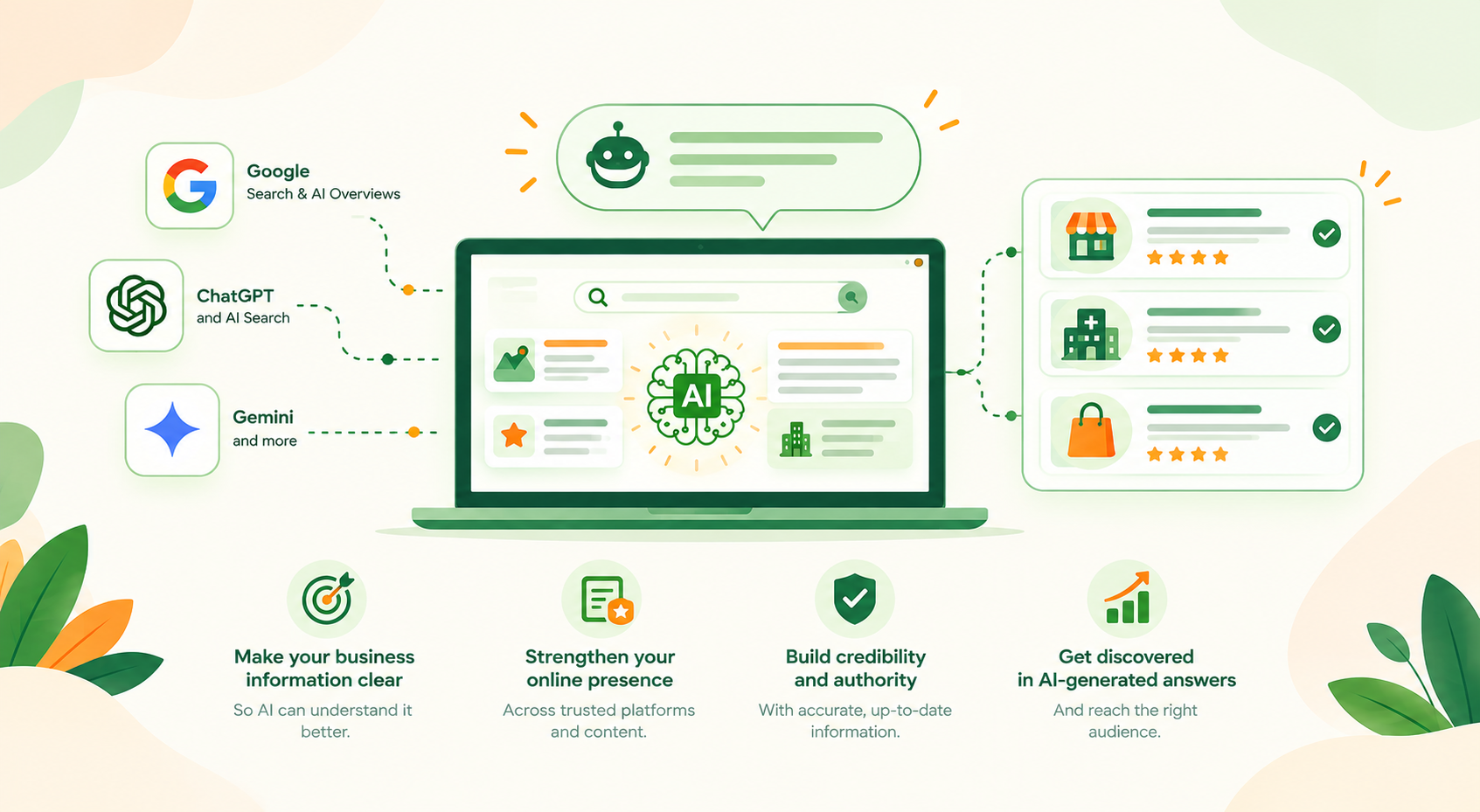
The answers generated by platforms such as ChatGPT, Google AI Overviews, Gemini, Perplexity and Bing Copilot can influence which businesses users discover and consider. This makes AI-Generated Recommendations an increasingly important part of modern search visibility.
For businesses, the objective is not simply to rank for another set of keywords. It is to build a strong, trustworthy digital presence that AI systems can understand, connect with relevant topics and potentially surface when users ask recommendation-based questions.
- What Are AI-Generated Recommendations?
- How AI-Powered Search Understands a Business
- Why Business Visibility in AI Is Becoming Important
- AI SEO, GEO and AI Search Optimization
- Build Strong Topical Authority
- Make Your Business Easy for AI to Understand
- Strengthen E-E-A-T and Real-World Expertise
- Build Relevant Brand Mentions and Third-Party References
- Optimize for Conversational Search
- Strengthen Technical SEO and Structured Information
- Think Beyond Rankings
- How Rajkar Helps Businesses Prepare for AI Search
- Frequently Asked Questions
What Are AI-Generated Recommendations?
AI-generated recommendations are suggestions provided by AI-powered search and conversational systems in response to a user's specific question or intent.
For example, a user might ask:
- “Which are the best SEO agencies for AI search optimization?”
- “Recommend a healthcare SEO company for a hospital.”
- “What are some reliable signage companies in Mumbai?”
- “Which local businesses offer premium interior design services?”
- “What should I look for when choosing an SEO agency?”
Instead of simply matching the exact words in the query, AI systems attempt to understand the context, intent, entities, relationships and available information before generating an answer.
This means a business may need more than a well-optimized service page. Its expertise, services, location, reputation, content, brand mentions and information across relevant online sources can all contribute to how clearly the business is understood.
How AI-Powered Search Understands a Business
AI systems process information from multiple signals and sources to understand businesses and their areas of expertise. The exact systems and ranking processes differ between platforms, so there is no single formula for appearing in every AI-generated answer.
However, several fundamentals remain important.
A clearly structured website helps search systems understand what a business does, who it serves, where it operates and what subjects it has expertise in. Detailed service pages, useful educational content, structured data and consistent business information can strengthen this understanding.
For example, an agency that wants to be associated with AI SEO should clearly explain its AI SEO services, optimization methodology, relevant expertise, use cases and related topics rather than simply repeating the phrase “AI SEO” throughout its website.
The same principle applies to healthcare providers, law firms, manufacturers, local businesses and professional service companies.
Why Business Visibility in AI Is Becoming Important
Traditional search visibility still matters, but the way users discover information is expanding.
A potential customer may now begin with a conversational search rather than a conventional keyword query. They may ask an AI platform to compare providers, explain available options or recommend businesses based on specific requirements.
This creates a new consideration for marketers: Is your business information clear and credible enough to be understood in an AI-powered search environment?
Being visible in AI-generated answers should not replace traditional SEO. Instead, it should complement strong organic search performance, local visibility, brand building and a technically sound website.
AI SEO, GEO and AI Search Optimization
AI SEO focuses on improving a website and brand's ability to be understood and discovered across AI-powered search experiences while maintaining strong traditional SEO foundations.
AI Search Optimization takes this further by considering how content, entities, structured information and authority may support visibility in conversational and generative search experiences.
GEO (Generative Engine Optimization) is commonly used to describe optimization approaches designed for generative search environments. While terminology varies across the industry, the underlying principle is similar: create useful, authoritative and well-structured information that can be understood by both people and modern search systems.
Effective optimization should not mean producing large volumes of AI-generated content. It should mean creating information that genuinely answers customer questions and demonstrates real expertise.
Build Strong Topical Authority
AI systems need context. A single service page may communicate what you sell, but a connected collection of high-quality content can provide a much deeper understanding of your expertise.
Suppose an SEO agency offers AI Search Optimization. Instead of publishing only one page targeting “AI SEO,” it can develop useful resources around:
- AI-powered search
- Google AI Overviews
- ChatGPT recommendations
- conversational search
- entity optimization
- structured data
- topical authority
- E-E-A-T
- local AI search visibility
These topics should connect naturally through internal linking and provide genuine value to readers.
Over time, this creates a stronger topical ecosystem instead of a website built around isolated keywords.
Make Your Business Easy for AI to Understand
Clear information is one of the most practical foundations of AI Search Optimization.
Your website should make it easy to identify:
- What your business offers
- Who your services are for
- Your areas of expertise
- Locations you serve
- Industries you work with
- Key products or services
- Experience and credentials
- Contact and business information
Avoid vague service descriptions that force users or search systems to guess what you actually provide.
For example, instead of saying “We deliver innovative digital solutions,” a service page should clearly explain whether the company provides SEO, web development, PPC, AI SEO, local SEO or another specific service.
Strengthen E-E-A-T and Real-World Expertise
Trust becomes particularly important when AI systems are generating recommendations.
Businesses should demonstrate Experience, Expertise, Authoritativeness and Trustworthiness (E-E-A-T) through genuine evidence. Depending on the industry, this can include detailed author information, professional credentials, case studies, project experience, original insights, client outcomes, expert commentary and transparent business information.
For a healthcare business, for example, qualifications, practitioner information, treatment expertise and accurate medical information are especially important.
For an SEO agency, practical case studies, documented methodologies, expert-authored content and demonstrated experience can provide stronger signals than generic claims about being a “leading” or “best” company.
Build Relevant Brand Mentions and Third-Party References
AI visibility is not only about what your own website says about your business.
Relevant third-party references can help establish broader context around a brand. Depending on the business, these may include industry publications, professional directories, reputable review platforms, associations, interviews, partnerships and other credible sources.
The focus should be on relevance and quality, not collecting as many mentions or links as possible.
For example, a healthcare company being discussed by credible healthcare publications or professional organizations can provide stronger contextual value than unrelated directory listings.
Optimize for Conversational Search
People often phrase questions to AI systems differently from traditional Google searches.
Instead of searching:
“SEO agency Mumbai”
a user might ask:
“Can you recommend an SEO agency in Mumbai that specializes in AI search optimization?”
Similarly:
Traditional search: “best neurologist Mumbai”
Conversational search: “Can you recommend a neurologist in Mumbai for someone looking for a specialist?”
Understanding these natural-language questions can help businesses create content that directly addresses real customer intent.
FAQ sections, service explanations, comparison content and detailed informational pages can all support this approach when they provide genuinely useful answers.
Strengthen Technical SEO and Structured Information
AI Search Optimization does not eliminate technical SEO. Search engines and AI-powered experiences still need to access, interpret and understand website information.
Businesses should maintain crawlable pages, logical internal linking, appropriate canonicalization, descriptive metadata, fast and mobile-friendly experiences, clean site architecture and relevant structured data.
Schema markup can help communicate information about entities such as organizations, local businesses, services, articles and other eligible content types. It should accurately reflect visible information on the page rather than being used simply to add more keywords.
Think Beyond Rankings
There is no guaranteed method for making ChatGPT, Gemini, Google AI Overviews, Perplexity or Bing Copilot recommend a particular business.
AI-generated recommendations can vary based on the query, context, available information, location, freshness and the systems used to generate the response.
The more sustainable approach is to build a strong digital footprint that makes your business relevant, understandable, authoritative and trustworthy.
That means combining traditional SEO with AI Search Optimization, strong content, entity clarity, E-E-A-T, technical foundations, brand authority and genuine customer-focused information.
How Rajkar Helps Businesses Prepare for AI Search
At Rajkar, we approach AI SEO as an extension of strong search fundamentals rather than a shortcut around them. Our approach combines technical SEO, semantic content, entity optimization, structured information, topical authority, E-E-A-T and conversational search optimization.
The goal is to help businesses build a digital presence that is easier for search engines and AI-powered systems to understand while also providing a better experience for real customers.
If your business is visible on Google but rarely appears when potential customers ask AI systems for recommendations, an AI SEO audit can help identify opportunities to strengthen your AI Search Visibility.
Frequently Asked Questions
1. What are AI-generated recommendations?
AI-generated recommendations are suggestions provided by AI-powered search or conversational systems when users ask questions about businesses, products, services or solutions.
2. Can businesses guarantee appearing in ChatGPT recommendations?
No. Businesses cannot guarantee recommendations, rankings or citations from ChatGPT or other AI platforms. Optimization can improve the quality and clarity of a business's digital presence, but AI-generated results remain dynamic.
3. What is AI SEO?
AI SEO is an approach to search optimization that considers both traditional search engines and AI-powered search experiences. It focuses on content quality, entities, authority, structured information, technical SEO and user intent.
4. What is GEO in SEO?
GEO, or Generative Engine Optimization, generally refers to strategies designed to improve visibility in generative and AI-powered search experiences.
5. How does AI Search Optimization help businesses?
AI Search Optimization helps make business information clearer, more authoritative and easier for modern search systems to interpret. It can include content optimization, entity understanding, structured data, technical SEO and conversational search optimization.
6. Does traditional SEO still matter for AI search?
Yes. Technical SEO, quality content, crawlability, internal linking, authority and strong user experience remain important foundations for broader search visibility.
7. How can I optimize my website for conversational search?
Start by understanding the questions your customers actually ask. Create clear, comprehensive answers around services, comparisons, problems, use cases and recommendations rather than focusing only on short keyword phrases.
8. Do brand mentions help with AI visibility?
Relevant and credible brand mentions can contribute to a stronger overall digital footprint and help establish context around a business. Quality and relevance are more important than simply generating large numbers of mentions.
9. Is schema markup important for AI SEO?
Structured data can help communicate specific information about a business, service, organization or content to search engines. It should be implemented accurately and consistently with the information users can see on the website.
10. How can I measure my AI Search Visibility?
AI visibility can be monitored by testing relevant conversational queries across different AI search platforms, tracking brand mentions and recommendations, reviewing the sources associated with AI answers and identifying gaps in your website's content and authority.