
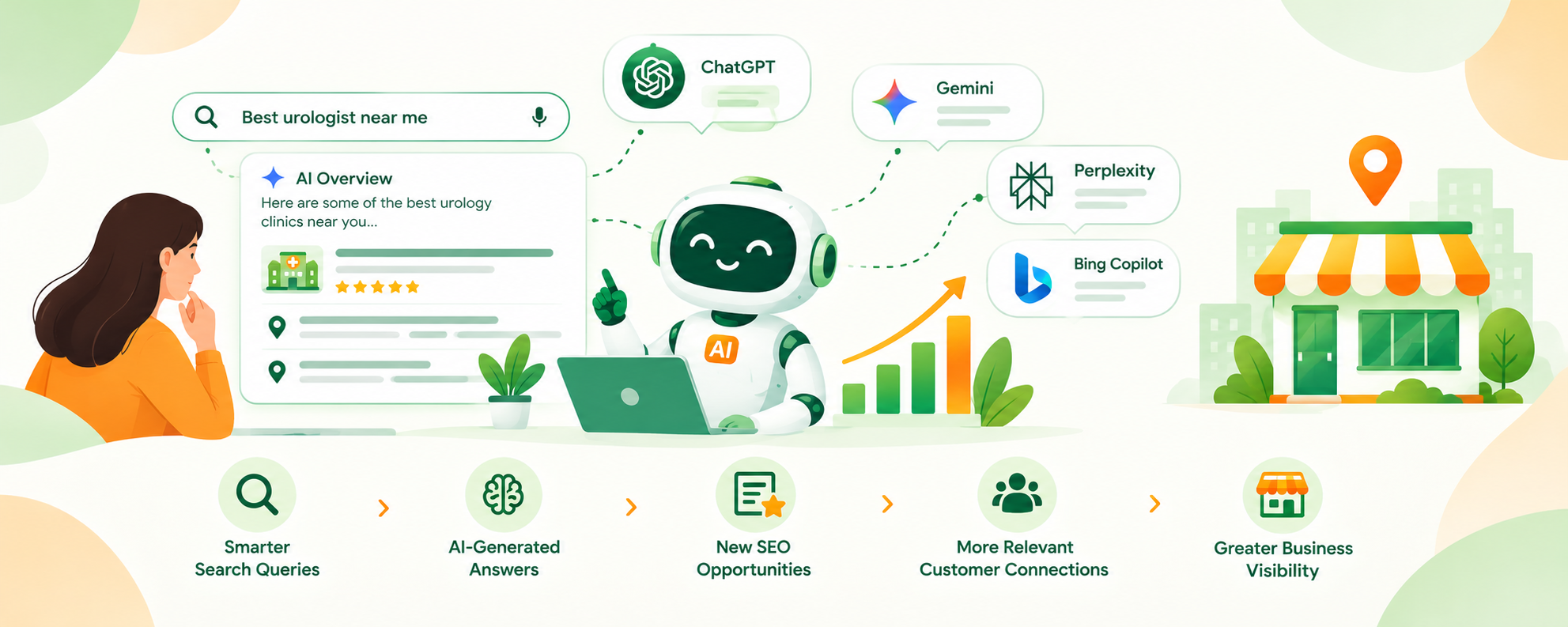
Search is changing faster than ever. People are no longer relying only on traditional Google results to find a business, compare services, or make buying decisions. They are increasingly using AI-powered experiences such as Google AI Overviews, ChatGPT search, Google Gemini, and Perplexity AI to discover information and evaluate brands.
This shift is changing how businesses need to approach AI SEO. Instead of optimizing only for rankings and clicks, businesses now need to build content, authority, and digital signals that help both search engines and AI systems understand what they offer, who they serve, and why they are trustworthy.
For businesses focused on long-term online visibility, understanding this change is becoming essential.
- What Is AI SEO?
- How AI Is Changing the Way People Search
- How Google AI Overviews Are Changing SEO
- The Role of Google AI Overviews in Modern SEO
- How ChatGPT Search, Gemini, and Perplexity Affect Discovery
- Why AI Search Visibility Matters for Businesses
- How Businesses Can Adapt Their SEO Strategies
- The Future of SEO Is About Being Findable Everywhere
- Frequently Asked Questions
- Conclusion
What Is AI SEO?
AI SEO is the practice of optimizing a website and its digital presence so that its information can be understood, surfaced, and referenced across both traditional search engines and AI-powered search experiences.
Traditional SEO focuses heavily on factors such as keywords, technical performance, backlinks, content quality, and search rankings. AI SEO expands this approach by placing greater emphasis on context, entities, search intent, credibility, and how clearly information can be interpreted by AI systems.
A strong AI SEO strategy may include:
- Creating useful, experience-driven content
- Structuring information clearly
- Building topical authority
- Strengthening brand and entity signals
- Optimizing for conversational search queries
- Improving technical SEO and website accessibility
- Supporting content with relevant evidence and trustworthy sources
The goal is not to manipulate AI systems. It is to make a business easier for both people and intelligent search systems to understand.
How AI Is Changing the Way People Search
AI is changing search from a simple keyword-based activity into a more conversational discovery process.
Previously, someone might search for “best digital marketing agency in Mumbai” and browse several results. Today, they may ask an AI platform which agencies are suitable for a specific business need and expect a summarized recommendation.
This creates a new layer of competition.
Businesses are no longer competing only for a position on a search results page. They are also competing to become a source that AI systems consider useful, relevant, and credible.
Search Is Becoming More Conversational
Users can now ask detailed questions instead of entering short keywords. For example:
- “Which SEO agency can help a B2B company increase qualified leads?”
- “What SEO strategy should a local business use in 2026?”
- “Which agency specializes in AI search optimization?”
These questions contain more context and reveal stronger search intent. Businesses therefore need content that answers specific questions rather than simply repeating target keywords.
How Google AI Overviews Are Changing SEO
Google AI Overviews can provide AI-generated summaries directly within search results, giving users information without requiring them to open multiple webpages.
This does not make traditional SEO irrelevant. Strong organic visibility, crawlable content, useful information, and website authority remain important foundations.
However, businesses should think beyond ranking for one keyword.
Content should:
- Provide direct answers
- Explain topics in sufficient depth
- Address related questions
- Demonstrate genuine expertise
- Use clear headings and logical structure
- Connect related concepts naturally
- Provide accurate and trustworthy information
For example, an SEO agency should not only create a page targeting AI SEO services. It can also explain how AI search works, what affects AI search visibility, how businesses can adapt their content, and how success can be measured.
This broader topical coverage helps create a stronger and more useful resource.
The Role of Google AI Overviews in Modern SEO
Google AI Overviews are changing how users interact with search results by providing AI-generated summaries for certain queries.
This does not mean traditional SEO has become irrelevant. Strong organic visibility, helpful content, technical accessibility, and trustworthy information remain important.
However, businesses should think beyond ranking for individual keywords. Content should clearly explain topics, answer related questions, demonstrate expertise, and connect relevant concepts.
For example, an SEO agency discussing AI SEO should explain what AI SEO means, how it differs from traditional SEO, which platforms matter, how visibility can be measured, and what businesses can realistically expect.
This depth helps create a stronger information ecosystem around the brand.
How ChatGPT Search, Gemini, and Perplexity Affect Discovery
AI-powered platforms are creating additional ways for potential customers to discover businesses.
ChatGPT Search
ChatGPT search allows users to explore topics through conversational questions. Businesses can improve their chances of being discovered by publishing authoritative, well-structured information that directly addresses user needs.
Google Gemini
Google Gemini represents another important part of the evolving AI ecosystem. As users increasingly interact with AI assistants for research and recommendations, businesses need consistent information across their website and other trusted digital sources.
Perplexity AI
Perplexity AI emphasizes answer-driven discovery and often provides sources alongside its responses. This makes accurate, well-supported content particularly valuable for businesses seeking stronger AI search visibility.
The important point is that no single platform should become the entire SEO strategy. Businesses should build a strong digital foundation that can support visibility across multiple search experiences.
Why AI Search Visibility Matters for Businesses
AI search visibility refers to how easily a brand, business, product, or service can be discovered and represented in AI-generated search experiences.
A business may rank well for traditional keywords but still have limited visibility when customers ask AI platforms for recommendations.
Improving AI search visibility involves strengthening several areas:
- Clear and comprehensive website content
- Consistent business information
- Strong topical relevance
- Demonstrated expertise and experience
- Authoritative references and mentions
- Structured data where appropriate
- Positive reputation and trustworthy brand signals
- Content that directly satisfies user intent
This is why modern SEO strategies need to consider both traditional search and AI-assisted discovery.
How Businesses Can Adapt Their SEO Strategies
Adapting does not require abandoning the fundamentals of SEO. Instead, businesses should build on them.
1. Create Content Around Real Customer Questions
Start with the problems customers actually have. Build pages and articles that provide direct, practical answers instead of producing content solely to target keywords.
2. Demonstrate Real Expertise
Google's emphasis on helpful, reliable content makes genuine expertise increasingly valuable. Include original insights, practical examples, relevant experience, and accurate information wherever possible.
3. Strengthen Topical Authority
Rather than publishing disconnected articles, develop related content around important business topics. This helps establish a clearer relationship between your services, expertise, and the problems you solve.
4. Make Information Easy to Understand
Avoid unnecessarily complicated language.
A strong page should quickly communicate:
What you do → Who you help → What problem you solve → How you solve it → Why your approach is credible → What the visitor should do next.
5. Keep Technical SEO Strong
AI optimization does not replace technical SEO. Search engines still need to crawl, render, and understand your website. Mobile usability, page speed, indexability, internal linking, structured data, and accessibility should remain part of the foundation.
The Future of SEO Is About Being Findable Everywhere
The future of search is becoming more fragmented. Customers may discover a business through Google Search, Google AI Overviews, ChatGPT search, Google Gemini, Perplexity AI, maps, social platforms, reviews, or other digital channels.
That means businesses should stop thinking about SEO as simply achieving a blue-link ranking.
The bigger objective is discoverability: making your business understandable, credible, and useful wherever potential customers search for answers.
Frequently Asked Questions
1. What is AI SEO?
AI SEO is the process of optimizing a website and its content to improve visibility across traditional search engines and AI-powered search platforms. It focuses on search intent, helpful content, topical authority, entities, technical SEO, and trustworthy information.
2. How is AI changing SEO?
AI is making search more conversational and answer-focused. Instead of relying only on traditional search results, users can ask detailed questions through platforms such as Google AI Overviews, ChatGPT search, Google Gemini, and Perplexity AI. Businesses therefore need content that clearly answers customer questions and demonstrates expertise.
3. Why is AI search visibility important for businesses?
AI search visibility helps businesses become discoverable when potential customers use AI platforms to research products, services, or companies. Strong content, brand authority, accurate information, and relevant digital signals can help businesses build visibility across emerging search experiences.
4. Are traditional SEO strategies still important with AI search?
Yes. Traditional SEO remains an important foundation for AI SEO. Technical SEO, quality content, internal linking, website performance, crawlability, authority, and search intent continue to matter. AI SEO builds on these fundamentals rather than replacing them.
5. How can businesses optimize for Google AI Overviews, ChatGPT search, and Perplexity AI?
Businesses should create original, useful, well-structured content that directly answers relevant customer questions. They should also maintain consistent business information, demonstrate real expertise, strengthen topical authority, and ensure their website is technically accessible to search engines and AI systems.
6. Can AI SEO help businesses get more customers?
Yes, when implemented as part of a broader SEO strategy. AI SEO can help businesses increase their visibility across search and AI discovery platforms, allowing potential customers to find useful information about their products or services at different stages of the buying journey.
Conclusion
AI is not replacing SEO; it is expanding what effective SEO needs to accomplish. Businesses now have more opportunities to be discovered, but they also need a more complete approach to online visibility.
A modern AI SEO strategy combines strong technical foundations, helpful content, topical authority, clear business information, and credible digital signals. By adapting their SEO strategies for Google AI Overviews, ChatGPT search, Google Gemini, Perplexity AI, and other emerging search experiences, businesses can prepare for a search landscape where visibility depends on much more than rankings alone.
The brands that focus on being genuinely useful, trustworthy, and easy to understand will be better positioned to earn attention as search continues to evolve.