
When patients search online for a doctor, hospital, treatment, diagnostic service, or answers to a health concern, search visibility can influence which healthcare providers they discover first. But improving visibility in healthcare requires more than applying general SEO techniques to a medical website.
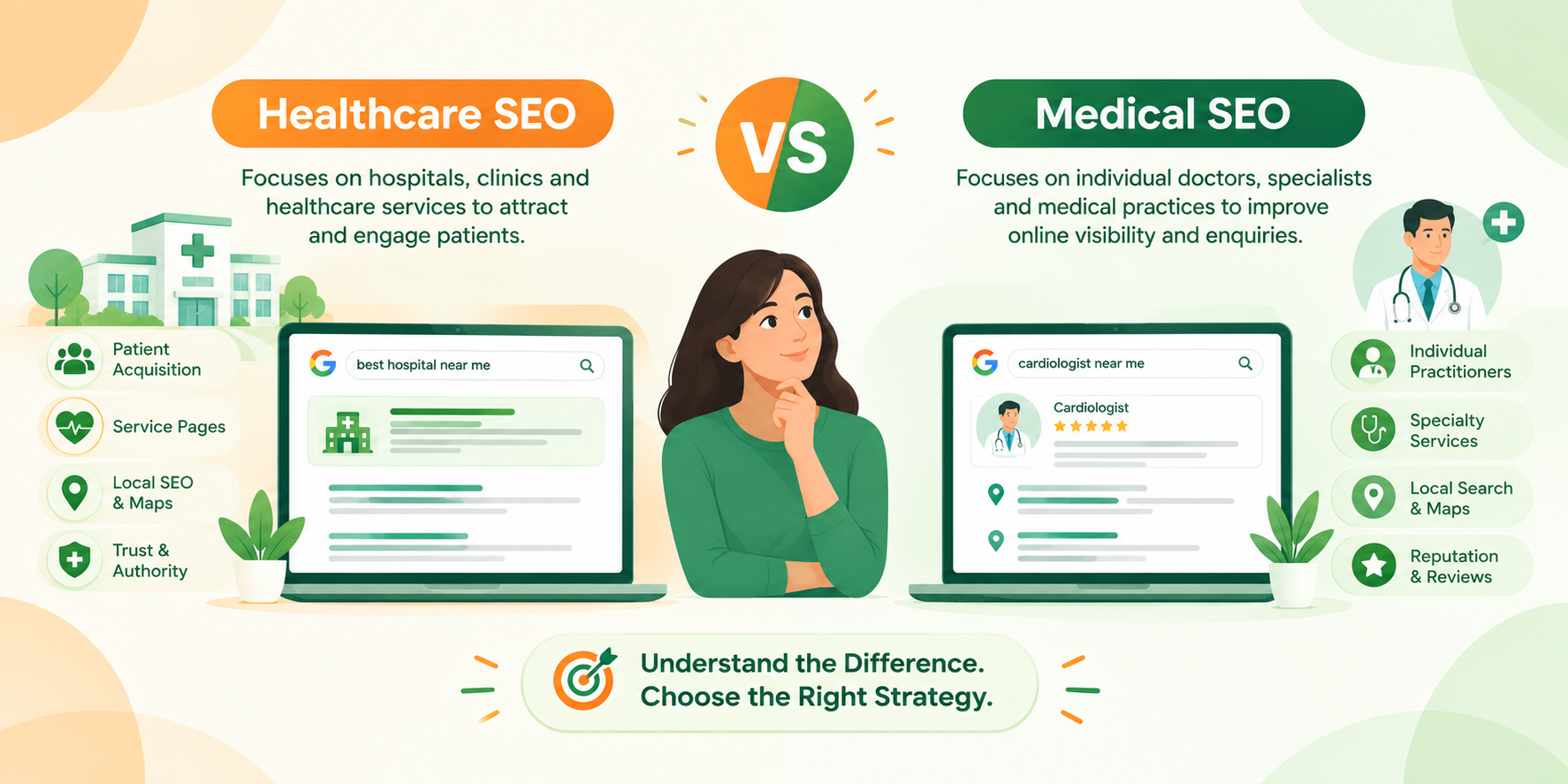
This is where the distinction between Healthcare SEO and Medical SEO becomes useful. Although the terms are often used interchangeably, they can represent different scopes of search optimization. Healthcare SEO generally covers the broader digital presence of healthcare organizations, while Medical SEO often focuses more specifically on doctors, medical practices, clinical specialties, treatments, and health-related content.
Both approaches require a strong understanding of YMYL (Your Money or Your Life) content and Google's E-E-A-T principles. Accuracy, expertise, trustworthy information, technical quality, local visibility, and patient experience should remain central to the strategy.
- What Is Healthcare SEO?
- What Is Medical SEO?
- Healthcare SEO vs Medical SEO: What's the Difference?
- Which Strategy Does Your Healthcare Business Need?
- Why YMYL Matters for Both Healthcare and Medical SEO
- Healthcare Content Strategy vs Medical Content Strategy
- Search Intent Should Drive the SEO Strategy
- Local SEO Is Essential for Patient Discovery
- Optimize Healthcare Websites for AI Search
- Healthcare Website Optimization: What Both Strategies Need
- How to Choose Between Healthcare SEO and Medical SEO
- How Healthcare SEO Services Can Bring Both Strategies Together
- Common Mistakes to Avoid
- Frequently Asked Questions
- Conclusion
What Is Healthcare SEO?
Healthcare SEO is the broader process of improving the online visibility of healthcare organizations and their services in search engines and emerging AI-powered search experiences.
It can apply to:
- Hospitals
- Multispecialty clinics
- Healthcare networks
- Diagnostic centres
- Medical institutions
- Specialty healthcare providers
- Wellness and preventive healthcare organizations
- Healthcare service brands
A comprehensive Healthcare SEO Strategy may cover the organization's website, service pages, specialty pages, doctor profiles, local search presence, educational content, technical SEO, and AI Search Optimization.
The goal is to connect healthcare organizations with relevant users at different stages of the patient journey.
For example, a hospital may need visibility for searches related to cardiology, neurology, emergency services, diagnostics, treatments, locations, and individual specialists. Healthcare SEO brings these different areas together under a broader search strategy.
What Is Medical SEO?
Medical SEO is a more specialized area of SEO focused on medical professionals, practices, clinical specialties, treatments, procedures, conditions, and medically relevant information.
Medical SEO may be particularly relevant for:
- Doctors
- Surgeons
- Specialists
- Medical practices
- Specialty clinics
- Individual treatment services
- Medical departments
- Condition-specific resources
A Medical SEO Strategy focuses heavily on matching patient search intent with accurate medical information and relevant clinical services.
For example, a urologist may optimize pages around kidney stone treatment, urinary conditions, prostate health, diagnostic procedures, and specialist consultations. A neurologist may build visibility around neurological conditions, treatments, symptoms, and specialist services.
Healthcare SEO vs Medical SEO: What's the Difference?
The primary difference is scope and focus.
| Healthcare SEO | Medical SEO |
|---|---|
| Broader healthcare industry focus | More specialized medical focus |
| Often used by hospitals and healthcare organizations | Often used by doctors, specialists and medical practices |
| Covers multiple departments and services | Focuses on specialties, treatments and conditions |
| Includes broader healthcare brand visibility | Focuses heavily on medical search intent |
| Can cover multiple locations and facilities | Often emphasizes specialist and practice visibility |
| Includes organizational content and services | Includes medical expertise and educational content |
| May combine healthcare, local and AI search strategies | Requires particularly strong medical content and trust signals |
The two approaches overlap significantly. A large hospital, for example, may need Healthcare SEO at the organizational level while using Medical SEO principles for individual departments and specialist pages.
Therefore, they should not necessarily be treated as competing strategies.
Which Strategy Does Your Healthcare Business Need?
The right approach depends on your organization, services, audience, location, and search goals.
Hospitals and Multispecialty Healthcare Organizations
A hospital generally benefits from a broader Healthcare SEO Strategy because it may need to optimize hundreds of pages across specialties, doctors, treatments, locations, facilities, and patient resources.
The strategy can include:
- Hospital SEO
- Specialty SEO
- Doctor profile optimization
- Local SEO
- Healthcare content strategy
- Technical SEO
- Healthcare schema
- AI Search Optimization
Medical SEO principles can then be applied to individual departments, doctors, conditions, and treatment pages.
Individual Doctors and Specialists
A doctor or specialist will generally need a more focused Medical SEO Strategy.
The website should establish clear connections between the doctor's expertise and the conditions, treatments, procedures, and services patients are searching for.
Important areas may include:
- Doctor profile SEO
- Specialty pages
- Condition and treatment content
- Local search visibility
- Medical FAQs
- Professional credentials
- Medical review information
- Appointment pathways
Clinics and Specialty Practices
Clinics often need a combination of both.
For example, a fertility clinic may require broader healthcare visibility for its brand and location while using Medical SEO for fertility treatments, procedures, conditions, specialists, and patient questions.
A combined approach can therefore provide broader visibility while maintaining strong topical relevance.
Why YMYL Matters for Both Healthcare and Medical SEO
Healthcare and medical content falls within the YMYL category because online information can affect people's health and wellbeing.
This makes quality and trust particularly important.
SEO should never encourage a healthcare organization to publish inaccurate, exaggerated, or misleading information simply to attract traffic.
A responsible strategy should prioritize:
- Medical accuracy
- Qualified expertise
- Transparent authorship
- Medical review where appropriate
- Reliable references
- Updated information
- Clear healthcare provider details
- Responsible medical claims
- Patient-focused communication
Apply E-E-A-T to Healthcare Content
E-E-A-T—Experience, Expertise, Authoritativeness, and Trustworthiness—should be incorporated into healthcare content and website development.
Healthcare websites can strengthen these signals by clearly presenting:
- Doctor qualifications and credentials
- Professional experience
- Author and medical reviewer information
- Healthcare organization details
- Relevant professional affiliations
- Reliable medical references
- Content publication and review dates
- Transparent information about services
These signals should reflect genuine expertise rather than being added simply for SEO purposes.
Healthcare Content Strategy vs Medical Content Strategy
Content is another area where the two approaches can differ.
Healthcare Content Strategy
A broader Healthcare Content Strategy may cover topics such as:
- Hospital services
- Departments
- Patient resources
- Diagnostics
- Preventive care
- Healthcare facilities
- General health education
Medical Content Strategy
A Medical Content Strategy tends to go deeper into:
- Conditions
- Symptoms
- Treatments
- Procedures
- Clinical specialties
- Recovery information
- Medical questions
- When to seek professional care
The best content should answer the patient's actual question rather than simply repeat keywords.
For YMYL content, medical information should be created or reviewed appropriately and supported by reliable sources when necessary.
Search Intent Should Drive the SEO Strategy
Patients use different types of healthcare searches depending on where they are in their journey.
Informational Intent
Examples include:
- What are kidney stone symptoms?
- What causes migraine?
- How is cataract surgery performed?
Educational content can address these searches.
Commercial Investigation
Users may compare providers, treatments, specialists, or healthcare facilities. Examples include:
- Best urologist for kidney stones
- Neurology clinic in Mumbai
- Cataract treatment options
Detailed service and specialist pages can address this intent.
Transactional or Appointment Intent
These users are closer to taking action. Examples include:
- Book urologist appointment
- Cardiologist near me
- Hospital near me
- Diagnostic centre in Mumbai
Service pages, doctor profiles, local SEO, and clear appointment pathways become particularly important.
A strong strategy connects all three stages instead of focusing exclusively on high-volume informational keywords.
Local SEO Is Essential for Patient Discovery
Healthcare decisions are frequently location-dependent. Patients often want a provider they can physically access.
This makes Local SEO for Healthcare an important component of both Healthcare SEO and Medical SEO.
Optimization can include:
- Google Business Profile
- Accurate name, address, and phone information
- Appropriate healthcare categories
- Service information
- Location pages
- Doctor location details
- Authentic patient reviews
- Local references
- Consistent business information
For doctors and clinics, local visibility can be especially valuable because searches such as “doctor near me” and “specialist in [location]” often indicate strong intent.
Optimize Healthcare Websites for AI Search
The healthcare search experience is also evolving beyond traditional search results.
Google AI Overviews, AI Mode, ChatGPT, Gemini, Perplexity, and other AI-powered experiences can synthesize information from multiple sources.
This makes AI Search Optimization for Healthcare increasingly relevant.
Healthcare and medical websites should provide information that is:
- Clear
- Accurate
- Well structured
- Contextually complete
- Easy to interpret
- Supported by credible information
- Consistent across important digital properties
Question-based headings, concise explanations, structured content, FAQs, clear doctor information, and strong entity signals can help search systems better understand the organization and its expertise.
AI visibility should not be approached through guarantees. No SEO provider can responsibly promise that a particular healthcare website will appear in every AI-generated answer or citation.
The priority should remain authoritative, useful, technically accessible information.
Healthcare Website Optimization: What Both Strategies Need
Regardless of whether you call the approach Healthcare SEO or Medical SEO, the underlying website needs a strong technical foundation.
Important areas include:
Mobile Experience
Many patients search for healthcare information from mobile devices. Pages should load efficiently and remain easy to navigate on smaller screens.
Clear Site Architecture
Organize content logically around doctors, specialties, treatments, conditions, services, and locations.
Internal Linking
Connect related pages naturally. A condition page might link to a relevant treatment, specialist, diagnostic service, and appointment page.
Technical SEO
Address issues involving crawlability, indexing, canonicalization, page speed, broken links, duplicate content, and other technical factors.
Structured Data
Where appropriate, use accurate structured data to help search engines understand organizations, physicians, local businesses, services, breadcrumbs, and other relevant entities.
How to Choose Between Healthcare SEO and Medical SEO
Instead of choosing one term exclusively, consider the primary business model and search journey.
Choose a broader Healthcare SEO Strategy when your organization has:
- Multiple departments
- Multiple healthcare services
- Several locations
- A hospital or healthcare network
- Large-scale patient resources
- Multiple specialists
Prioritize Medical SEO when the primary focus is:
- An individual doctor
- A specialist
- A medical practice
- A specific treatment
- A particular condition
- A specialty clinic
For many healthcare organizations, the strongest strategy combines both.
The organization can build broad healthcare authority while applying specialized Medical SEO to doctors, conditions, treatments, and clinical services.
How Healthcare SEO Services Can Bring Both Strategies Together
Professional Healthcare SEO Services can integrate broader organizational optimization with specialist medical search strategies.
A practical approach may include:
The exact strategy should be based on the healthcare organization's goals rather than applying the same checklist to every website.
Common Mistakes to Avoid
Whether implementing Healthcare SEO or Medical SEO, avoid:
- Creating content solely for keywords
- Publishing unsupported medical claims
- Using generic or outdated medical information
- Hiding doctor credentials
- Publishing medical content without appropriate review
- Creating duplicate location pages
- Ignoring local search
- Neglecting technical SEO
- Overusing medical keywords
- Treating AI search visibility as guaranteed
- Focusing only on rankings instead of patient engagement
Healthcare SEO should support patient trust rather than compromise it.
Frequently Asked Questions
1. What is the difference between Healthcare SEO and Medical SEO?
Healthcare SEO is generally broader and can cover hospitals, clinics, healthcare networks, diagnostic centres, services, locations, and organizational visibility. Medical SEO is more specialized and focuses on doctors, medical practices, specialties, conditions, treatments, procedures, and medical content. The two approaches often overlap.
2. Is Medical SEO important for individual doctors?
Yes. Medical SEO can help doctors and specialists improve visibility for relevant searches involving their specialty, conditions, treatments, location, and services. Doctor profile optimization, medically responsible content, local SEO, credentials, and clear appointment pathways can all contribute to a stronger online presence.
3. Do hospitals need Healthcare SEO or Medical SEO?
Most hospitals benefit from a combination of both. Healthcare SEO can support the broader hospital brand, departments, locations, and services, while Medical SEO principles can be applied to individual doctors, specialties, conditions, procedures, and treatment pages.
4. Why is E-E-A-T important for medical websites?
Healthcare content can influence important health decisions, making expertise and trust particularly important. Medical websites can strengthen E-E-A-T by clearly presenting qualified professionals, accurate information, medical review details where appropriate, reliable references, professional credentials, and transparent organizational information.
5. Can Healthcare SEO improve visibility in AI search?
Healthcare SEO can make website information easier for AI-powered search systems to understand by improving content structure, technical accessibility, entity information, topical coverage, and trust signals. However, no SEO strategy can guarantee inclusion in a specific AI-generated answer or citation.
6. Should a healthcare organization use both Healthcare SEO and Medical SEO?
In many cases, yes. Healthcare SEO can provide the broader strategic framework, while Medical SEO can address specific doctors, specialties, conditions, treatments, and clinical search intent. Combining the two can create a more comprehensive search strategy without treating them as competing approaches.
Conclusion: Healthcare SEO and Medical SEO Work Best Together
The difference between Healthcare SEO and Medical SEO is primarily one of scope. Healthcare SEO typically addresses the broader digital visibility of hospitals, healthcare organizations, clinics, and their services, while Medical SEO focuses more deeply on doctors, specialties, conditions, treatments, and medical search intent.
For many organizations, the strongest approach is not choosing one over the other. It is combining both.
A well-developed strategy brings together Healthcare Search Visibility, Medical SEO Strategy, Healthcare Content Strategy, E-E-A-T, YMYL best practices, Local SEO, Healthcare Website Optimization, and AI Search Optimization.
Most importantly, healthcare SEO should remain patient-first. Accurate information, qualified expertise, transparent content ownership, reliable sources, and a clear path to care should form the foundation of every optimization decision.
When search optimization and genuine healthcare expertise work together, organizations can build a more trustworthy digital presence while making it easier for relevant patients to discover the care and information they are looking for.