
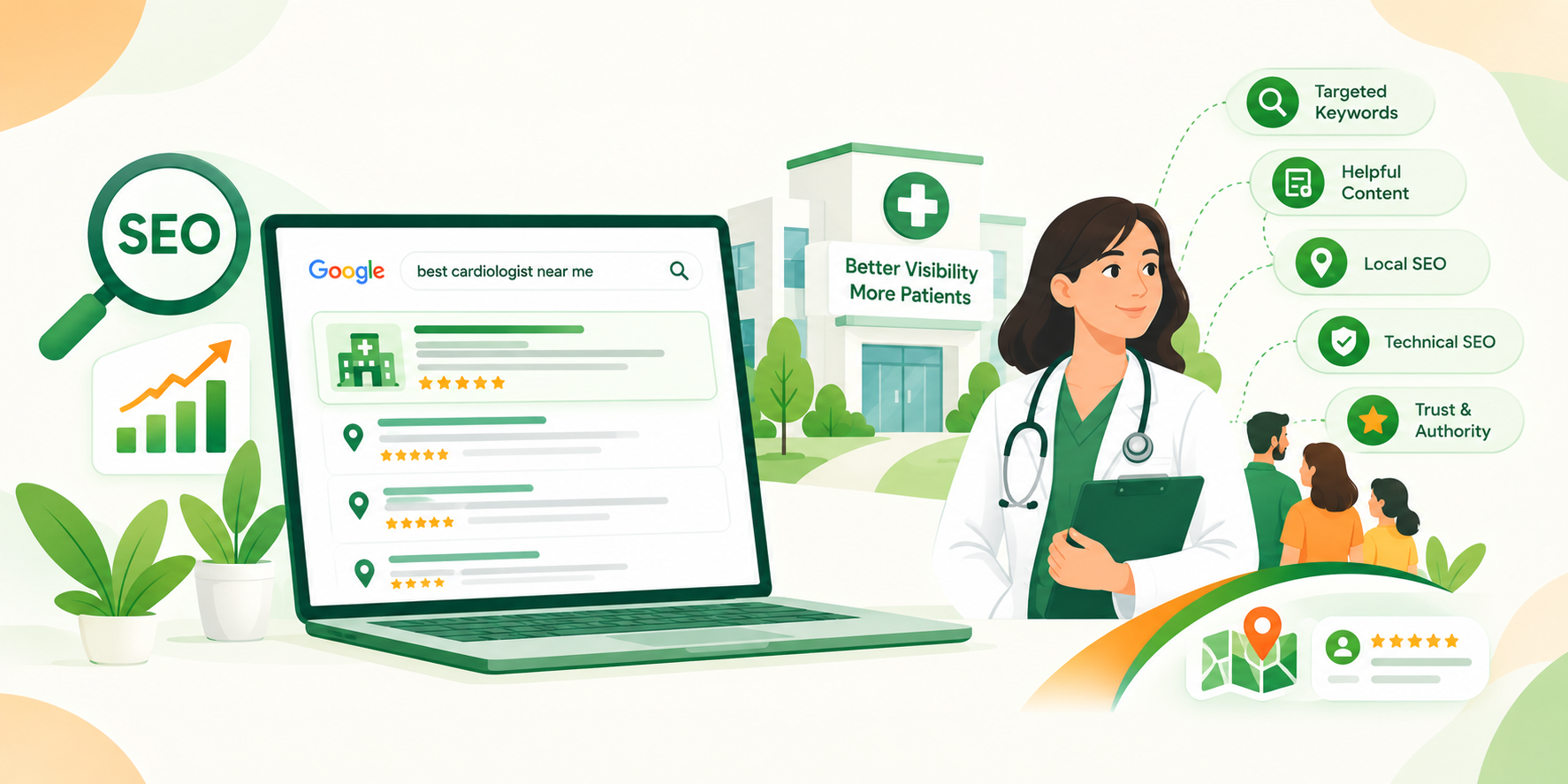
Patients increasingly begin their healthcare journey online. They search for doctors, hospitals, symptoms, treatments, specialists, diagnostic services, and answers to important health questions before deciding what to do next.
Because healthcare is a Your Money or Your Life (YMYL) topic, search visibility alone is not enough. Healthcare websites need to provide accurate, trustworthy, experience-led information that demonstrates E-E-A-T—Experience, Expertise, Authoritativeness, and Trustworthiness while making it easy for patients to understand their options.
A strong Healthcare SEO Strategy brings these priorities together through healthcare website optimization, Medical SEO Strategy, Doctor SEO, medically responsible content, local search optimization, technical SEO, and AI Search Optimization. The goal is not simply to attract more visitors, but to help the right patients discover reliable healthcare information and credible providers when they need them.
- What Is a Healthcare SEO Strategy?
- Why Healthcare SEO Matters for Patient Acquisition
- YMYL and E-E-A-T: The Foundation of Healthcare SEO
- Create Medically Responsible Healthcare Content
- Build Healthcare Topical Authority
- Strengthen Healthcare Website Optimization
- Strengthen Local Healthcare Search Visibility
- Optimize Healthcare Content for AI Search
- Maintain Healthcare Content Freshness
- Avoid Unsupported Medical Claims
- Measure Healthcare SEO Beyond Rankings
- How Healthcare SEO Services Support Sustainable Growth
- Frequently Asked Questions
- Conclusion
What Is a Healthcare SEO Strategy?
A Healthcare SEO Strategy is a structured approach to improving a healthcare organization's visibility in search while providing useful, accurate, and trustworthy information to patients.
Unlike general SEO, healthcare SEO requires a higher level of attention to content accuracy, professional expertise, transparency, and user trust. This is especially important when pages discuss medical conditions, symptoms, treatments, procedures, or healthcare decisions.
A comprehensive strategy can include:
- Healthcare website optimization
- Medical keyword research
- Doctor and specialist SEO
- Healthcare content strategy
- Local SEO and Google Business Profile optimization
- Technical SEO
- Internal linking and website architecture
- Healthcare schema markup
- E-E-A-T optimization
- AI Search Optimization
- Patient-focused conversion optimization
The objective is to build sustainable Healthcare Search Visibility while creating a digital experience that patients can confidently use.
Why Healthcare SEO Matters for Patient Acquisition
Patients often turn to search engines before contacting a healthcare provider. A person may search for a symptom, a specialist, a treatment, a nearby hospital, or information about a procedure.
For example, searches may include:
- Best cardiologist near me
- Urologist in Mumbai
- Treatment for kidney stones
- Neurologist for migraine
- Hospital for neurological care
- Diagnostic centre near me
- Symptoms of urinary infection
These searches reflect different stages of the patient journey. Someone searching for symptoms may still be researching, while someone searching for a specialist or hospital may already be ready to make an appointment.
A strong Medical SEO Strategy connects useful website content with these different search intents.
Turn Search Visibility Into Patient Enquiries
Getting a patient to visit a website is only the first step. The website should make it easy for them to understand:
Clear navigation, credible information, accessible contact details, and relevant calls to action can help transform organic visibility into meaningful patient engagement.
YMYL and E-E-A-T: The Foundation of Healthcare SEO
Healthcare falls within YMYL (Your Money or Your Life) because information published online can influence a person's health, wellbeing, and medical decisions.
Healthcare SEO should never focus on rankings at the expense of accuracy or patient safety.
Experience, Expertise, Authoritativeness and Trustworthiness
A healthcare website should demonstrate E-E-A-T throughout its important pages.
Experience
Explain genuine healthcare services, clinical capabilities, facilities, and areas of practice accurately.
Expertise
Clearly identify qualified doctors, specialists, medical writers, or reviewers responsible for healthcare information.
Authoritativeness
Support important medical information with credible sources such as recognized medical institutions, government health organizations, professional associations, clinical guidelines, and appropriate research.
Trustworthiness
Provide transparent, accurate, current information and clearly communicate who operates the healthcare organization and how patients can contact it.
E-E-A-T should be part of the content creation process rather than something added after an article has been written.
Create Medically Responsible Healthcare Content
Content is a major component of Healthcare SEO Services, but healthcare content should not be produced simply to target keywords.
A strong Medical Content Strategy should answer genuine patient questions while maintaining medical accuracy and appropriate context.
Useful healthcare content can cover:
- Symptoms and conditions
- Treatment options
- Medical procedures
- Specialist expertise
- Diagnostic services
- Preventive healthcare
- Recovery and aftercare
- Frequently asked patient questions
- When to seek professional medical attention
Include Medical Review and Content Ownership
Important healthcare content should clearly communicate who created and reviewed it. Where appropriate, pages can include:
- Author name and professional background
- Medical reviewer name and credentials
- Publication date
- Medical review or update date
- Relevant qualifications
- References and supporting sources
- Information about the editorial or medical review process
These details help patients understand the origin and credibility of the information.
Use Reliable and Current Medical Sources
Medical knowledge and recommendations can change. Therefore, healthcare websites should establish a process for reviewing important content regularly.
Depending on the topic, information may be supported by:
- Government health organizations
- Recognized hospitals and medical institutions
- Professional medical associations
- Peer-reviewed research
- Established clinical guidelines
- Other reputable healthcare resources
Sources should genuinely support the information presented rather than being included merely to make a page appear authoritative.
Build Healthcare Topical Authority
Healthcare Topical Authority means developing a comprehensive and logically connected body of content around relevant medical specialties and patient needs.
Instead of publishing isolated articles, healthcare organizations can create content clusters. For example, a urology website could develop connected resources around:
This structure helps users move naturally from general information to relevant services.
Internal linking should connect related pages in meaningful ways. A condition page may link to a relevant specialist, treatment page, diagnostic service, and appointment page.
This creates a stronger information architecture while helping search engines understand the relationship between healthcare topics.
Strengthen Healthcare Website Optimization
Technical and on-page SEO helps search engines and AI systems understand healthcare websites efficiently.
Create a Clear Website Structure
Healthcare websites should organize information logically around:
- Specialties
- Doctors
- Conditions
- Treatments
- Procedures
- Locations
- Diagnostic services
- Patient resources
A clear structure improves navigation and makes it easier for both users and search systems to understand the organization's areas of expertise.
Optimize Titles and Headings
Every important page should have a descriptive title and logical heading hierarchy. Keywords should be incorporated naturally, but headings should primarily help patients understand the page.
Improve Internal Linking
Relevant internal links can guide users from informational content toward appropriate service and specialist pages. For example, a page explaining kidney stones could naturally link to a kidney stone treatment page, urologist profile, diagnostic service, and appointment page.
Use Appropriate Structured Data
Relevant structured data can help search engines understand entities and page information. Depending on the page, healthcare websites may use appropriate structured data for organizations, physicians, local businesses, breadcrumbs, services, and FAQs.
Structured data should accurately represent visible information and should never be used to make unsupported medical claims.
Strengthen Local Healthcare Search Visibility
For hospitals, clinics, doctors, and diagnostic centres, local search is an important part of patient acquisition.
A strong local SEO strategy should include:
- Accurate Google Business Profile information
- Correct address and contact details
- Appropriate business categories
- Updated healthcare services
- Location-specific website content
- Authentic patient reviews
- Relevant photographs
- Consistent business information across important platforms
Location pages should provide genuine information about the facility and the patients it serves rather than simply creating multiple pages with different city names.
Optimize Healthcare Content for AI Search
Search is increasingly evolving beyond traditional search results. Google AI Overviews, AI Mode, ChatGPT, Gemini, Perplexity, and other AI-powered search experiences can synthesize information from multiple sources.
This makes AI Search Optimization increasingly relevant to healthcare organizations.
Healthcare content should be:
- Clearly structured
- Factually accurate
- Direct and easy to understand
- Contextually complete
- Supported by credible information
- Organized around real patient questions
- Connected to clear healthcare entities
- Technically accessible to search systems
Question-based headings, concise answers, detailed explanations, FAQs, structured information, and strong entity signals can help make healthcare content easier for modern search systems to interpret.
No healthcare SEO agency can guarantee that a website will appear in a particular AI-generated response or citation. The responsible objective is to build authoritative, accessible, and useful information.
Maintain Healthcare Content Freshness
YMYL content should not be treated as a publish-once activity. Healthcare organizations should periodically review important pages for:
- Medical accuracy
- Treatment information
- Clinical recommendations
- Doctor credentials
- Service availability
- Statistics
- References
- Contact information
- Broken or outdated links
- Medical terminology
- Publication and review dates
A defined content review process helps maintain accuracy while strengthening user trust and long-term Healthcare Search Visibility.
Avoid Unsupported Medical Claims
Healthcare SEO should never encourage exaggerated or misleading claims simply because they may attract clicks. Avoid statements involving:
- Guaranteed treatment outcomes
- Guaranteed cures
- “100% effective” treatments
- Unsupported superiority claims
- Fear-based messaging
- Misleading statistics
- Unverified medical benefits
Instead, healthcare content should communicate information accurately, acknowledge that individual circumstances vary, and encourage readers to consult an appropriately qualified healthcare professional for personal medical advice.
Where appropriate, healthcare pages should also include a clear disclaimer explaining that general educational content does not replace professional medical consultation, diagnosis, or treatment.
Measure Healthcare SEO Beyond Rankings
Rankings alone do not show whether a healthcare SEO strategy is helping patients. Important performance indicators can include:
- Organic search traffic
- Non-branded search visibility
- Relevant keyword growth
- Engagement with healthcare service pages
- Doctor profile visits
- Appointment enquiries
- Organic calls
- Contact form submissions
- Local search interactions
- Google Business Profile activity
- Performance of high-intent landing pages
Connecting SEO performance with meaningful patient actions provides a clearer picture of business impact.
How Healthcare SEO Services Support Sustainable Growth
Professional Healthcare SEO Services can bring together technical SEO, medical content strategy, local search optimization, authority building, and performance analysis.
A structured approach can involve:
The strategy should be customized according to the healthcare organization's specialty, services, location, audience, website condition, and competitive environment.
Frequently Asked Questions
1. What is Healthcare SEO?
Healthcare SEO is the process of improving a healthcare website's visibility for relevant patient searches while providing accurate, useful, and trustworthy information. It includes technical SEO, medical content, local SEO, Doctor SEO, website optimization, structured data, and AI Search Optimization.
2. Why is YMYL important for healthcare SEO?
Healthcare is a YMYL topic because online information can influence people's health and medical decisions. Healthcare websites should therefore place greater emphasis on accuracy, expertise, trustworthy sources, transparency, medical review, and up-to-date information.
3. How can healthcare websites demonstrate E-E-A-T?
Healthcare websites can demonstrate E-E-A-T by identifying qualified authors and medical reviewers, displaying relevant credentials, providing accurate information, referencing reputable sources, maintaining updated content, clearly describing healthcare services, and providing transparent information about the organization and its professionals.
4. What type of content should healthcare websites publish?
Healthcare websites can publish condition guides, treatment information, procedure pages, specialist profiles, diagnostic information, preventive healthcare resources, patient FAQs, and educational articles. Content should be medically responsible, useful to patients, and reviewed or supported by qualified professionals where appropriate.
5. Can Healthcare SEO improve visibility in AI search?
A well-structured Healthcare SEO Strategy can make information easier for AI-powered search systems to understand by improving content quality, structure, entity information, technical accessibility, and authority signals. However, no SEO strategy can guarantee inclusion in a particular AI-generated answer or citation.
6. How long does Healthcare SEO take to show results?
The timeline varies based on factors such as website authority, technical health, competition, content quality, location, search demand, and the existing level of optimization. Some technical and on-page improvements can produce relatively quick benefits, while sustainable organic visibility and patient acquisition generally require consistent optimization over time.
Conclusion
A successful Healthcare SEO Strategy is not simply about appearing higher in search results. It is about helping patients find accurate information, understand available healthcare services, and discover credible providers when they need them.
From Healthcare Website Optimization and local SEO to Doctor SEO, Medical Content Strategy, Healthcare Topical Authority, E-E-A-T, and AI Search Optimization, every part of the strategy should support a trustworthy patient experience.
Because healthcare is a YMYL category, accuracy, transparency, professional expertise, reliable sourcing, content review, and ongoing updates should remain central to the SEO process.
Search visibility can bring patients to a website, but expertise, trust, accurate information, and a patient-first experience are what create a stronger and more responsible healthcare digital presence.