
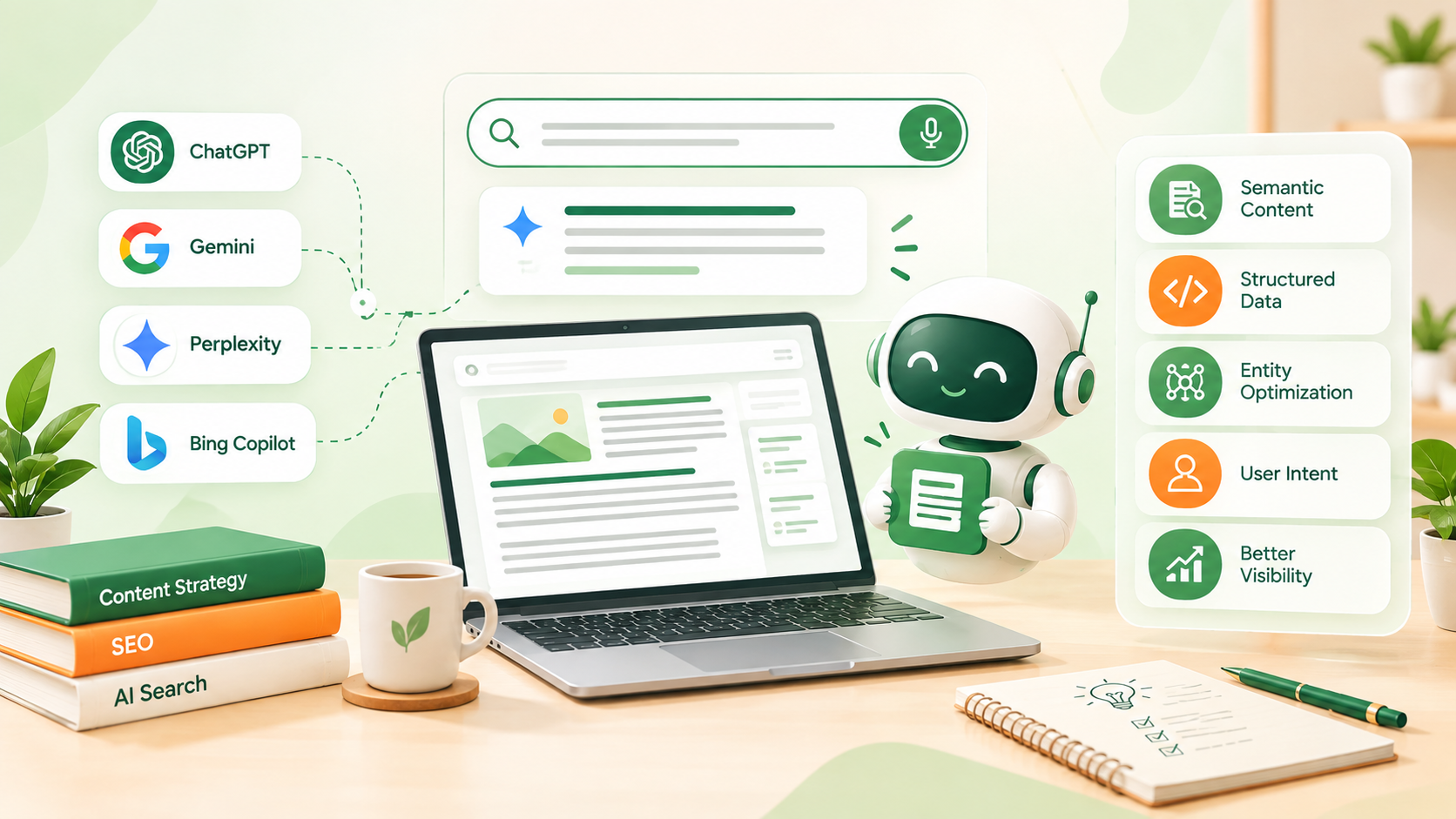
Search is changing rapidly. People are no longer relying only on traditional search results and blue links to find information. They are increasingly asking conversational questions through AI-powered platforms and expecting direct, useful answers.
Google AI Overviews, ChatGPT search, Gemini, Perplexity, and other AI-driven search experiences are changing how information is discovered, evaluated, and presented. For businesses, this means creating content that simply ranks for keywords is no longer enough. Your content also needs to be clear, trustworthy, contextually relevant, and easy for AI systems to understand.
AI-powered search optimization focuses on making website content useful for both people and modern search technologies. The goal is not to write specifically for an algorithm, but to create high-quality information that search engines and AI systems can confidently understand, retrieve, and reference.
- What Is AI-Powered Search Optimization?
- Why Content Needs to Be Optimized for AI Search
- 7 Ways to Optimize Content for AI-Powered Search Engines
- AI SEO and GEO: Understanding the Connection
- How ChatGPT Search and AI Overviews Change Content Strategy
- Common Mistakes in AI Content Optimization
- A Practical AI Content Optimization Checklist
- Frequently Asked Questions
- Conclusion
What Is AI-Powered Search Optimization?
AI-powered search optimization is the process of structuring and improving online content so it can perform effectively across traditional search engines and AI-powered search experiences.
Traditional SEO often focuses on factors such as keywords, backlinks, technical performance, and search intent. These remain important, but AI search adds another layer: understanding meaning, context, entities, relationships, and the quality of information presented on a page.
Effective AI SEO helps search systems understand:
- What your business or website offers
- Who your content is intended for
- Which questions your content answers
- How your information relates to other topics
- Why your content is trustworthy and useful
This makes content optimization for AI an important part of a modern search strategy.
Why Content Needs to Be Optimized for AI Search
AI-powered search engines can interpret complex questions and combine information from multiple sources to generate responses. Instead of simply matching a keyword, these systems attempt to understand the user’s underlying intent.
For example, a user might search:
“What type of digital signage is best for a retail store?”
A traditional search may return pages targeting “digital signage for retail stores.” An AI-powered system may evaluate multiple factors, including the quality of explanations, product information, expertise, supporting evidence, and how clearly the content addresses the user’s question.
This creates an opportunity for businesses that publish genuinely helpful and well-structured content.
The shift from keywords to context
Modern search optimization is increasingly about topics and relationships rather than repeating exact phrases.
Your content should naturally cover:
- The main topic
- Related questions
- Important concepts
- Practical examples
- Relevant entities
- Benefits and limitations
- Expert recommendations
- Supporting evidence
This broader approach helps search systems understand the subject rather than simply identifying a keyword.
7 Ways to Optimize Content for AI-Powered Search Engines
1. Start With Search Intent
Before creating content, identify what the user actually wants to accomplish.
Search intent can be informational, commercial, navigational, or transactional. Understanding intent allows you to create content that directly satisfies the user’s needs.
For example, someone searching “how to optimize content for AI search” needs practical guidance, while someone searching “AI SEO services” may be comparing service providers.
Build your content around the questions and problems your target audience genuinely has.
2. Create Clear, Direct Answers
AI search systems need to identify useful information quickly. Make important answers easy to find.
Use descriptive H2 and H3 headings, concise paragraphs, bullet points, definitions, and question-based sections.
For example:
What is AI SEO?
AI SEO is the practice of optimizing digital content so it can be effectively understood and surfaced across AI-powered and traditional search experiences.
A clear answer like this gives both readers and search systems strong contextual signals.
3. Build Topic Depth With Semantic SEO
Semantic SEO helps search engines understand the meaning and relationships between concepts.
Instead of repeatedly using one keyword, cover closely related topics naturally.
For an article about AI-powered search optimization, relevant concepts could include:
- GEO
- AI Overviews
- ChatGPT search
- conversational search
- entity optimization
- structured data
- topical authority
- search intent
- E-E-A-T
- natural language queries
The goal is not to insert every related term. Instead, use concepts where they genuinely improve the reader’s understanding.
4. Demonstrate Experience and Expertise
AI systems increasingly need reliable information to generate useful answers. Businesses should therefore demonstrate real expertise through their content.
Follow the principles associated with Google’s E-E-A-T framework:
- Experience: Share practical observations, examples, and first-hand insights where appropriate.
- Expertise: Explain complex subjects accurately and clearly.
- Authoritativeness: Establish your business or authors as credible sources.
- Trustworthiness: Provide accurate information and avoid misleading claims.
Include author information, credible references where appropriate, original examples, case studies, and transparent explanations.
Generic content that simply repeats information available everywhere is less valuable than content that provides genuine expertise.
5. Structure Content for Machine and Human Understanding
Good structure benefits both users and AI systems.
Use:
- One clear H1
- Logical H2 and H3 headings
- Short paragraphs
- Descriptive lists
- Comparison tables where useful
- FAQs
- Internal links
- Relevant schema markup
Structured content makes it easier to understand the relationship between different sections of a page.
However, structured data should accurately represent visible page content. It should support your content rather than be used to manipulate search results.
6. Optimize for Conversational Search
People interact with AI platforms differently from traditional search engines. They often ask complete questions instead of typing short keywords.
For example:
Traditional query: “AI SEO benefits”
Conversational query: “How can AI SEO help my business appear in AI-generated search results?”
Create content that naturally addresses these longer, conversational questions.
FAQ sections, detailed explanations, and question-based headings can help cover different ways users may express the same intent.
7. Keep Information Accurate and Up to Date
AI search is evolving quickly, so outdated information can reduce the usefulness of your content.
Review important pages regularly and update:
- Statistics
- Industry trends
- Platform features
- Examples
- Best practices
- Product or service information
- References and sources
Do not make claims simply because they sound authoritative. Prioritize accuracy, transparency, and evidence.
AI SEO and GEO: Understanding the Connection
AI SEO is a broader approach to optimizing websites and content for AI-driven discovery alongside traditional search.
GEO (Generative Engine Optimization) is an emerging term used for approaches focused specifically on improving how content is represented or discovered within generative AI experiences.
The two concepts overlap.
A modern strategy can combine:
Technical SEO → Search Intent → Semantic SEO → Helpful Content → Entity Optimization → Structured Data → GEO → AI Search Visibility
However, there is no guaranteed formula for getting a website cited, mentioned, or included in an AI-generated response.
The most sustainable approach is to create information that is genuinely useful, accurate, clearly structured, and relevant to the user’s question.
How ChatGPT Search and AI Overviews Change Content Strategy
Platforms such as ChatGPT search and Google’s AI Overviews can provide users with synthesized answers rather than requiring them to visit several search results.
This makes content quality particularly important.
Businesses should focus on becoming a reliable source of information by answering specific questions, demonstrating expertise, supporting important claims, and building strong topical authority.
The objective should not be to “game” AI systems. Instead, create content that deserves to be discovered and referenced because it provides a clear and trustworthy answer.
Common Mistakes in AI Content Optimization
Avoid these common approaches:
- Keyword stuffing
- Publishing generic AI-generated content without human review
- Creating pages solely to target search queries
- Making unsupported claims
- Copying competitor content
- Ignoring technical SEO
- Using irrelevant semantic keywords
- Creating FAQs that do not provide genuine value
- Publishing outdated information
AI optimization works best when it complements strong fundamentals rather than replacing them.
A Practical AI Content Optimization Checklist
Before publishing a page, ask:
If the answer is yes, your page has a stronger foundation for both traditional search and AI-powered discovery.
Frequently Asked Questions
1. What is AI-powered search optimization?
AI-powered search optimization is the process of creating and structuring content so search engines and AI-powered platforms can understand its meaning, context, relevance, and usefulness.
2. How is AI SEO different from traditional SEO?
Traditional SEO focuses heavily on rankings, keywords, technical performance, and links. AI SEO incorporates these fundamentals while placing greater emphasis on context, entities, conversational queries, semantic relevance, and information quality.
3. What is GEO in SEO?
GEO, or Generative Engine Optimization, focuses on improving how content can appear or be referenced in responses generated by AI-powered search and answer engines.
4. Does ChatGPT search replace Google SEO?
No. ChatGPT search represents another discovery channel rather than a complete replacement for traditional search. Businesses should build content that performs well across multiple search experiences.
5. How can I optimize content for Google AI Overviews?
Create accurate, useful, well-structured content that directly answers relevant questions, demonstrates expertise, covers the topic comprehensively, and follows strong SEO and technical best practices.
6. Can AI-generated content rank in search results?
AI-generated content can potentially appear in search results, but using AI does not automatically make content valuable. Content should provide original value, be accurate, useful, appropriately reviewed, and created primarily for people rather than solely to manipulate rankings.
Conclusion
Search is moving from simple keyword matching toward more contextual and conversational experiences. As platforms such as Google AI Overviews and ChatGPT search become increasingly important, businesses need to think beyond traditional rankings.
Effective AI-powered search optimization starts with the same principle that has always mattered: create genuinely useful content for your audience. Add semantic depth, clear structure, credible expertise, accurate information, and a strong understanding of search intent.
When AI SEO, semantic SEO, and GEO are integrated with sound technical and content practices, your website is better positioned to remain discoverable as search continues to evolve.