
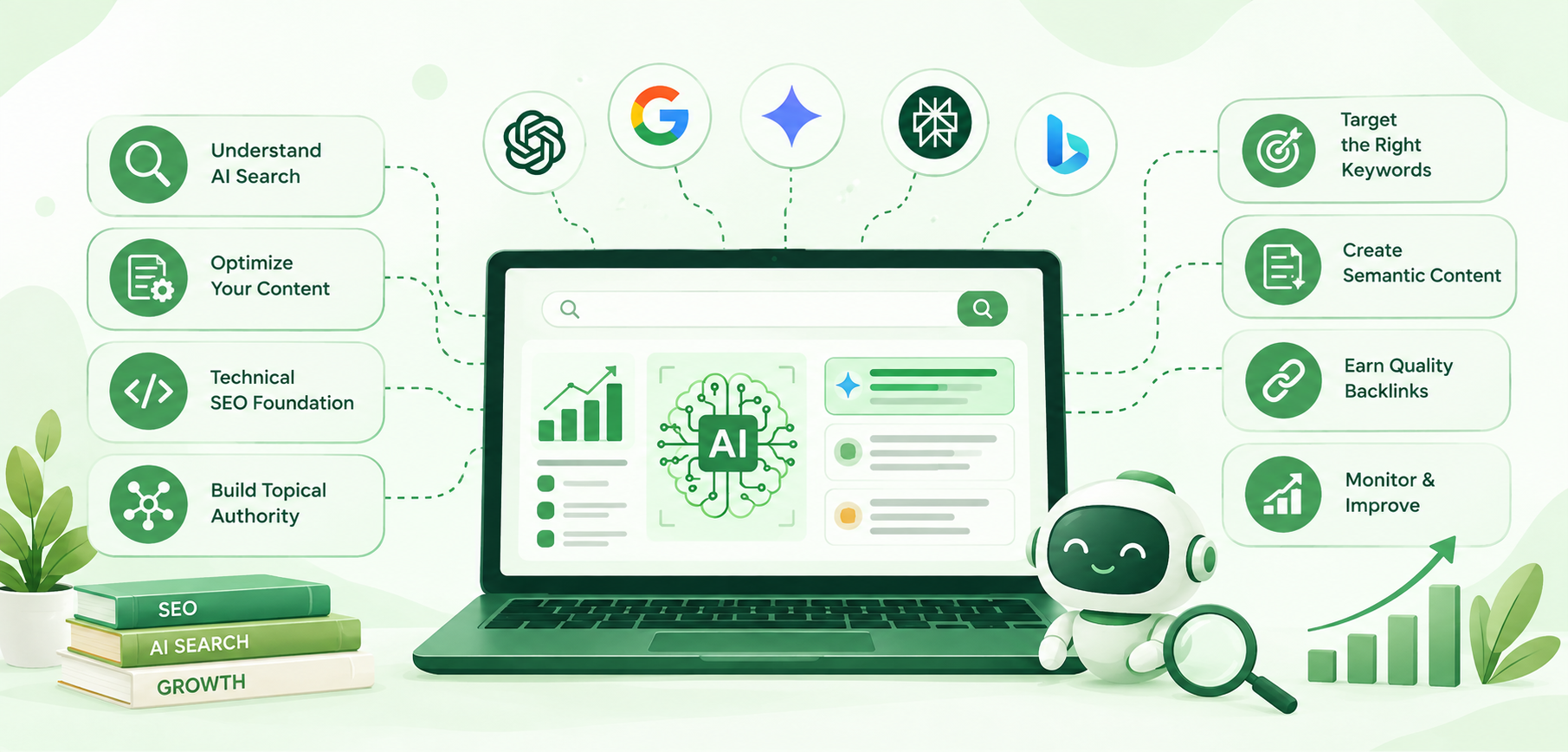
Search is changing faster than ever. People are no longer relying only on traditional Google results to find information. They are increasingly using AI-powered search experiences such as Google AI Overviews, ChatGPT, Microsoft Copilot, Gemini, Perplexity, and other generative search platforms to discover brands, compare products, research services, and make decisions.
This shift does not mean traditional SEO is becoming irrelevant. Instead, SEO is expanding.
An effective SEO strategy now needs to help a website:
- Rank in traditional search results.
- Become visible in AI-generated answers.
- Earn citations and mentions from trusted sources.
- Provide information that search engines and AI systems can understand.
- Demonstrate genuine expertise, experience, authority, and trust.
This is what an AI-ready SEO strategy is designed to accomplish.
- What Is an AI-Ready SEO Strategy?
- Why Businesses Need an AI-Ready SEO Strategy
- SEO vs. AI-Ready SEO
- Step 1: Define Your Search and AI Visibility Goals
- Step 2: Identify Your Core Topics, Entities, and Search Intent
- Step 3: Build Topic Clusters Instead of Isolated Blog Posts
- Step 4: Create Content That Directly Answers Questions
- Step 5: Strengthen E-E-A-T Signals
- Step 6: Optimize Your Website for Entities
- Step 7: Improve Technical SEO and Crawlability
- Step 8: Use Structured Data Where Appropriate
- Step 9: Build an AI-Friendly Content Structure
- Step 10: Create Original Information AI Systems Can Reference
- Step 11: Build Authority Beyond Your Website
- Step 12: Optimize for Conversational Search
- Step 13: Optimize for Comparison and Recommendation Queries
- Step 14: Measure AI Search Visibility
- Step 15: Keep Improving Based on Search Data
- AI-Ready SEO Strategy Checklist
- The Future of SEO Is Search Visibility, Not Just Rankings
- Frequently Asked Questions
What Is an AI-Ready SEO Strategy?
An AI-ready SEO strategy is an SEO approach designed to make a website easy for both search engines and AI systems to discover, understand, evaluate, retrieve, and reference.
Traditional SEO often focuses on rankings, keywords, backlinks, technical performance, and organic traffic.
AI-ready SEO expands these priorities to include:
- Entity optimization: Clearly establishing who you are, what your business does, what you offer, and where you operate.
- Answer optimization: Creating content that directly answers the questions people ask.
- Semantic relevance: Building meaningful connections between topics, entities, services, products, and locations.
- Structured information: Using headings, lists, tables, FAQs, schema, and clear content structures.
- Citation potential: Publishing useful information that AI systems can confidently reference.
- Brand authority: Building consistent mentions and recognition across relevant websites and platforms.
The goal is not simply to rank a page.
The goal is to make your brand understandable and useful across the entire search ecosystem.
Why Businesses Need an AI-Ready SEO Strategy
AI-powered search is changing the way users discover information.
Instead of searching:
“best SEO agency Mumbai”
a user may ask:
“Which SEO agencies in Mumbai specialize in AI search optimization, and what services do they offer?”
An AI system may then combine information from multiple sources to generate an answer.
This creates a new visibility opportunity.
A business may receive value from search even when the user does not click a traditional blue link. Your brand could be:
- Mentioned in an AI-generated answer.
- Included in a recommendation.
- Used as a supporting source.
- Referenced through a citation.
- Associated with a specific service or expertise.
- Discovered through branded or non-branded queries.
Therefore, modern SEO needs to optimize for visibility, relevance, authority, and citations—not rankings alone.
SEO vs. AI-Ready SEO
Traditional SEO and AI-ready SEO are closely connected, but their objectives are broader than they were previously.
| Traditional SEO | AI-Ready SEO |
|---|---|
| Keyword rankings | Search and AI visibility |
| Organic traffic | Visibility across search experiences |
| Keyword targeting | Topic and entity coverage |
| Backlinks | Relevant authority and citations |
| Optimized pages | Answer-focused content |
| Search snippets | Search and AI answer inclusion |
| Technical SEO | Machine-readable website structure |
| Domain authority | Brand/entity authority |
| FAQ sections | Conversational question coverage |
| Google optimization | Multi-platform search optimization |
This does not mean abandoning traditional SEO.
Instead, strong traditional SEO becomes the foundation of AI-ready SEO.
Step 1: Define Your Search and AI Visibility Goals
Before changing your website, establish what you want your SEO strategy to achieve.
Your goals should go beyond “increase rankings.”
Consider goals such as:
- Increase qualified organic traffic.
- Improve rankings for commercial keywords.
- Increase visibility in AI-generated answers.
- Earn more brand mentions across authoritative sources.
- Increase citations from relevant websites.
- Build topical authority around important services.
- Improve visibility for conversational queries.
- Increase qualified leads and conversions.
Make Your Goals Measurable
Instead of saying: “Improve AI visibility.”
Create a measurable objective such as: “Increase the number of relevant AI search queries where our brand is mentioned or cited over the next six months.”
Track traditional SEO metrics alongside AI-search metrics.
Useful measurements include:
- Organic clicks.
- Organic impressions.
- Keyword rankings.
- Search visibility.
- Brand searches.
- AI mentions.
- AI citations.
- Referring domains.
- Qualified leads.
- Conversion rate.
- Share of search visibility.
Step 2: Identify Your Core Topics, Entities, and Search Intent
Keywords remain useful, but an AI-ready strategy should not be built around keywords alone.
AI systems increasingly interpret relationships between topics, entities, concepts, questions, and context.
For example, an SEO agency should not only target:
“SEO agency Mumbai”
It should build content around related concepts such as:
- SEO services.
- Technical SEO.
- Local SEO.
- Ecommerce SEO.
- B2B SEO.
- AI SEO.
- Google AI Overviews.
- Generative Engine Optimization.
- Answer Engine Optimization.
- Content optimization.
- SEO audits.
- Keyword research.
- Link building.
- Search intent.
- Organic growth.
This creates a connected topical ecosystem.
Build an Entity Map
An entity map should connect:
Brand → Services → Expertise → Industries → Locations → Problems → Solutions
For example:
Brand: SEO Agency
Services: Technical SEO, Ecommerce SEO, Local SEO, AI SEO
Industries: Healthcare, B2B, SaaS, Ecommerce
Locations: Mumbai, India, United States, United Kingdom
Problems: Low rankings, declining traffic, poor AI visibility
Solutions: Technical improvements, content strategy, entity optimization, authority building
This helps users and machines understand what your business represents.
Step 3: Build Topic Clusters Instead of Isolated Blog Posts
One of the strongest ways to create an AI-ready website is to organize content into topic clusters.
Instead of publishing dozens of unrelated articles, create a central authoritative page supported by detailed subtopics.
For example:
Pillar Topic: AI SEO
Supporting topics could include:
- What is AI SEO?
- How does AI SEO work?
- Google AI Overviews SEO.
- ChatGPT SEO.
- Gemini SEO.
- Perplexity SEO.
- Generative Engine Optimization.
- AI citation optimization.
- AI search ranking factors.
- How to measure AI visibility.
Each article should connect naturally to related pages.
Why Topic Clusters Matter
Topic clusters help demonstrate depth.
They allow your website to cover:
- Definitions.
- Processes.
- Comparisons.
- Examples.
- Use cases.
- Problems.
- Solutions.
- FAQs.
Rather than answering one question, your website becomes a useful resource around an entire subject.
Step 4: Create Content That Directly Answers Questions
AI systems are designed to provide answers.
Your content should therefore make important answers easy to identify.
Avoid forcing users to read 1,500 words before finding the answer.
Instead, structure important sections like this:
What Is AI-Ready SEO?
AI-ready SEO is the process of optimizing a website so that search engines and AI-powered search systems can understand its content, expertise, entities, and relationships and potentially use that information in search results or generated answers.
Then explain the topic in greater depth.
This structure provides both:
- A concise answer.
- Supporting context.
Use Question-Based Content
Research the questions your audience actually asks.
Examples include:
- What is AI SEO?
- How does Google AI Overviews work?
- How can my website appear in AI search?
- Does traditional SEO help with AI search?
- How do AI systems choose sources?
- How can I improve AI citations?
- What makes content trustworthy?
- How should businesses measure AI visibility?
Answer each question clearly before expanding into detail.
Step 5: Strengthen E-E-A-T Signals
AI-ready SEO requires more than well-written content.
Your website should demonstrate Experience, Expertise, Authoritativeness, and Trustworthiness.
This becomes particularly important for topics involving health, finance, law, safety, and other areas where inaccurate information can cause harm.
Strengthen E-E-A-T by Showing:
- Real author information.
- Relevant professional experience.
- Author bios.
- Company information.
- Original research.
- First-hand examples.
- Case studies.
- Data and evidence.
- References to credible sources.
- Editorial standards.
- Clear contact information.
- Updated content where appropriate.
For example, instead of writing:
“SEO can increase website traffic.”
A stronger article could explain:
“In an ecommerce SEO campaign, traffic growth usually depends on technical accessibility, category-page optimization, product-page relevance, internal linking, search intent alignment, and authority.”
Specificity creates stronger evidence of expertise.
Step 6: Optimize Your Website for Entities
AI systems need to understand what entities represent.
Make your brand identity consistent across your website and external platforms.
Clearly communicate:
- Who you are.
- What you do.
- Who you serve.
- Where you operate.
- Which products or services you provide.
- What makes your organization different.
- Which people are associated with your organization.
Important Website Pages
An AI-ready website should generally have strong versions of:
- Homepage.
- About page.
- Service pages.
- Product pages.
- Industry pages.
- Location pages where genuinely relevant.
- Contact page.
- Author pages.
- Case studies.
- Resource or blog section.
Avoid creating large numbers of thin location or service pages simply to capture keywords.
Every page should provide a distinct reason for existing.
Step 7: Improve Technical SEO and Crawlability
AI-ready content cannot help much if search systems cannot properly access or understand your website.
Your technical SEO foundation should include:
- Crawlable pages.
- Indexable important content.
- Clean URL structures.
- Proper canonical tags.
- XML sitemaps.
- Logical internal linking.
- Mobile-friendly design.
- Fast page performance.
- Secure HTTPS.
- Correct robots.txt configuration.
- Appropriate redirects.
- Minimal duplicate content.
Make Important Content Easy to Discover
Your most valuable pages should not be buried several clicks deep.
Build clear navigation connecting:
Internal links should help both users and crawlers understand the relationship between pages.
Step 8: Use Structured Data Where Appropriate
Structured data can help search engines understand important entities and page relationships.
Depending on your website, relevant schema types may include:
- Organization.
- LocalBusiness.
- WebSite.
- WebPage.
- Article.
- Product.
- Service.
- BreadcrumbList.
- FAQPage where eligible and appropriate.
- Person.
- Review or AggregateRating where the underlying requirements are genuinely met.
Schema should support information that is actually visible and accurate on the page.
Do not use structured data as a shortcut for making unsupported claims.
Step 9: Build an AI-Friendly Content Structure
A strong AI-ready article should be easy to scan and easy to extract information from.
Use:
- One clear H1.
- Descriptive H2 sections.
- H3 subsections.
- Short paragraphs.
- Definitions.
- Bullet points.
- Numbered processes.
- Comparison tables.
- Examples.
- FAQs.
- Relevant statistics.
- Original insights.
Make Bullet Points Explainable
Avoid writing bullets such as:
- Improve content.
- Build links.
- Optimize SEO.
These are too vague.
Instead:
- Improve content depth: Cover the main question, related questions, practical examples, limitations, and decision-making information instead of repeating generic definitions.
- Build relevant authority: Earn mentions and links from websites that are genuinely connected to your industry, expertise, research, or audience.
- Optimize internal linking: Connect related pages using descriptive anchor text so users and search systems can understand how your content fits together.
The second format provides context and actionable information.
Step 10: Create Original Information AI Systems Can Reference
Generic content is everywhere.
Original information gives your website a stronger opportunity to become a useful source.
Consider publishing:
- Original research.
- Surveys.
- Industry benchmarks.
- Case studies.
- First-party data.
- Expert interviews.
- Proprietary frameworks.
- Detailed comparisons.
- Real campaign lessons.
- Original statistics.
- Practical experiments.
For example, instead of publishing another generic article about ecommerce SEO, publish:
“Ecommerce SEO Benchmark: 100 Product Pages Analyzed Across 10 Industries.”
Original research gives other websites something worth referencing.
Step 11: Build Authority Beyond Your Website
AI visibility is not purely a website problem.
Your brand’s presence across the broader web can influence how clearly your organization is represented online.
Develop relevant authority through:
- Industry publications.
- Expert interviews.
- Digital PR.
- Business directories.
- Professional organizations.
- Partner websites.
- Podcasts.
- Research publications.
- Relevant guest contributions.
- Reviews and testimonials.
- Social profiles.
The objective is not to generate thousands of artificial mentions.
The objective is to create credible, relevant, consistent evidence that your organization is a real authority in its field.
Step 12: Optimize for Conversational Search
People often interact with AI search tools differently from traditional search engines.
Traditional query:
“best CRM software”
Conversational query:
“What CRM is best for a small B2B sales team with a limited budget?”
Your content should address the context behind these questions.
Create sections covering:
- Who the solution is for.
- Who it is not for.
- Benefits.
- Limitations.
- Costs or pricing considerations.
- Alternatives.
- Use cases.
- Implementation requirements.
- Frequently asked questions.
This makes content more useful for decision-making queries.
Step 13: Optimize for Comparison and Recommendation Queries
AI search is frequently used during the consideration stage.
Users ask questions such as:
- Which option is better?
- What are the alternatives?
- Which service is best for my business?
- What should I choose?
- What are the advantages and disadvantages?
- Is this worth the investment?
Create helpful comparison content without manipulating the reader.
For example:
SEO Agency vs. In-House SEO Team
| Factor | SEO Agency | In-House Team |
|---|---|---|
| Hiring | Faster access to specialists | Requires recruitment |
| Expertise | Multiple specialists | Depends on team size |
| Cost | Flexible engagement models | Salaries and benefits |
| Control | Shared | Direct |
| Scalability | Usually easier | Requires additional hiring |
Balanced content can be more useful than purely promotional copy.
Step 14: Measure AI Search Visibility
AI SEO requires new measurement approaches.
Do not rely exclusively on traditional keyword rankings.
Create a set of representative prompts around your business.
For example:
- “Best SEO agencies for ecommerce businesses.”
- “Who provides AI SEO services in Mumbai?”
- “How do I improve my website’s visibility in AI search?”
- “Which agencies specialize in Google AI Overviews optimization?”
Then periodically record:
- Whether your brand is mentioned.
- Whether competitors are mentioned.
- Whether your website is cited.
- Which pages are referenced.
- What descriptions are used.
- Which competitors appear repeatedly.
- Which topics generate visibility.
This creates an AI visibility baseline.
Step 15: Keep Improving Based on Search Data
AI-ready SEO is not a one-time project.
Search behavior changes.
AI platforms evolve.
Competitors publish new content.
Search results change.
Your strategy should therefore operate as a continuous cycle:
Research → Create → Optimize → Publish → Measure → Improve
Review your content regularly.
Look for:
- Declining rankings.
- Missing topics.
- New search questions.
- Competitor content gaps.
- New AI search behavior.
- Outdated statistics.
- Weak sections.
- Pages with impressions but poor clicks.
- Pages that receive traffic but do not convert.
Then improve the content based on evidence.
AI-Ready SEO Strategy Checklist
Use this checklist when evaluating your website:
Strategy
- SEO goals are clearly defined.
- Target audiences and search intents are documented.
- Important business entities are identified.
- Priority topics are mapped.
Content
- Pillar pages cover important topics.
- Supporting content creates topic clusters.
- Questions are answered directly.
- Content includes useful examples.
- Important claims are supported.
- Content demonstrates real expertise.
- FAQs address genuine user questions.
Technical SEO
- Important pages are crawlable.
- Important pages are indexable.
- Internal linking is logical.
- Canonicals are implemented correctly.
- Sitemap is maintained.
- Mobile experience is strong.
- Core performance issues are addressed.
AI Search
- Conversational queries are covered.
- Entity relationships are clear.
- Brand information is consistent.
- AI visibility is monitored.
- Relevant citations and mentions are tracked.
- Competitor visibility is evaluated.
The Future of SEO Is Search Visibility, Not Just Rankings
AI-ready SEO does not replace traditional SEO.
It builds on it.
Technical SEO makes content accessible. Content strategy makes information useful. Entity optimization makes businesses understandable. E-E-A-T strengthens trust. Digital PR and authority building create external validation. Structured data helps machines interpret information.
Together, these elements create a stronger search presence.
The businesses most prepared for AI search will not necessarily be those publishing the most content. They will be the organizations that provide clear, trustworthy, specific, useful, and well-structured information across their website and the wider web.
The practical approach is simple:
That is the foundation of an AI-ready SEO strategy.
Frequently Asked Questions
1. What is AI-ready SEO?
AI-ready SEO is the process of optimizing a website so search engines and AI-powered search systems can understand, evaluate, retrieve, and potentially reference its information.
2. Is traditional SEO still important for AI search?
Yes. Technical SEO, quality content, authority, crawlability, relevance, and strong website architecture remain important foundations for broader search visibility.
3. How can I make my content more AI-friendly?
Use clear headings, direct answers, structured sections, relevant examples, tables, FAQs, trustworthy sources, and original insights. Make important information easy to understand and locate.
4. Does AI SEO mean targeting ChatGPT?
No. AI SEO should not focus on a single platform. A broader strategy can consider Google AI search experiences, ChatGPT, Gemini, Perplexity, Copilot, and other emerging search interfaces.
5. What is the difference between SEO and AI SEO?
Traditional SEO focuses heavily on organic search visibility and rankings. AI-ready SEO expands the strategy toward entities, conversational queries, AI-generated answers, citations, brand mentions, and machine-readable information.
6. How important is E-E-A-T for AI-ready SEO?
It is highly important, particularly for topics where expertise and accuracy matter. Demonstrating experience, expertise, authority, and trust helps establish why users and search systems should rely on your information.
7. Can backlinks improve AI search visibility?
Relevant backlinks can contribute to overall authority and discoverability, but AI visibility should not be reduced to backlink volume. The relevance and credibility of the sources mentioning your brand also matter.
8. Should every website create an FAQ section?
Not necessarily. FAQs are useful when they answer genuine questions from your audience. They should not be added simply to increase keyword coverage.
9. How do I measure AI search visibility?
Create a consistent set of relevant prompts and monitor brand mentions, citations, referenced pages, competitors, and changes over time. Combine this with traditional SEO metrics such as rankings, impressions, clicks, and conversions.
10. What is the first step toward an AI-ready SEO strategy?
Start with an audit. Evaluate your technical SEO, content quality, entity coverage, search intent, internal linking, authority, structured data, and current visibility across traditional and AI-powered search experiences.