
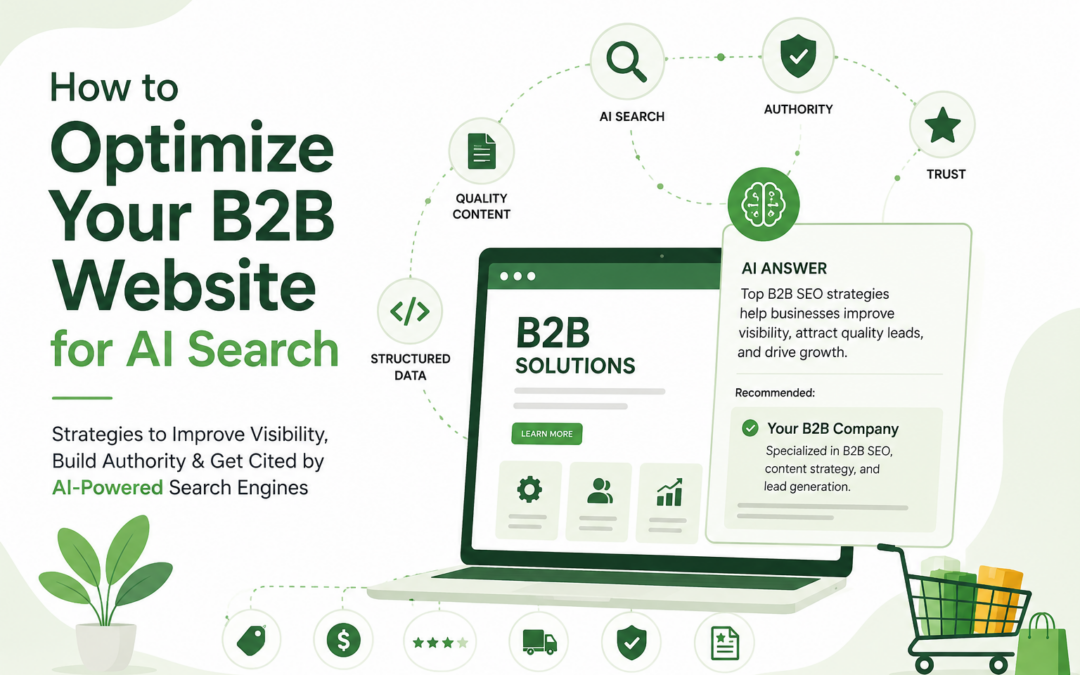
Buyers are asking AI platforms for shortlists before they ever open ten blue links. Here's how to make your company easy for those systems to understand, verify, and cite.
AI is changing how B2B buyers discover companies, compare vendors, and make purchasing decisions. Instead of relying exclusively on traditional Google search results, buyers are increasingly asking AI platforms for recommendations, comparisons, solutions, and shortlists.
Queries such as:
- "What are the best B2B SEO agencies in Mumbai?"
- "How can I improve organic visibility for my B2B website?"
- "Which SEO agency specializes in B2B SaaS?"
- "What should a B2B company do to appear in AI search results?"
can now generate direct answers, recommendations, and summarized information from multiple online sources.
This creates a new opportunity for B2B companies: being discovered inside AI-generated answers, not just traditional search results. That is where AI search optimization, Generative Engine Optimization (GEO), and Answer Engine Optimization (AEO) become important.
For B2B businesses, the objective isn't simply to rank for more keywords. The objective is to make your company, expertise, services, and content easy for search engines and AI systems to understand, verify, and potentially reference.
In this guide
What Does It Actually Mean to Optimize for AI Search?
AI search optimization means improving your website and broader online presence so that AI-powered search systems can understand your business, identify your expertise, extract useful information from your content, and potentially include your brand when generating answers.
Platforms such as ChatGPT, Perplexity, Google AI Overviews, and Gemini can synthesize information from multiple sources rather than simply displaying a list of ten blue links.
Traditional SEO typically focuses on:
- Keyword rankings
- Organic traffic
- Backlinks
- Search visibility
- Click-through rates
AI search optimization expands this approach to include:
- Entity recognition
- Topical authority
- Content structure
- First-hand expertise
- Structured data
- Brand consistency
- Third-party mentions
- Answer-focused content
- AI crawler accessibility
- Citability
The difference is important. A traditional SEO strategy may ask:
"How can we rank this page for B2B SEO services?"
An AI search strategy also asks:
"Does this page clearly explain what B2B SEO services are, who they are for, what they include, and why this company is qualified to provide them?"
The second approach creates content that is useful not only for search engines but also for users and AI systems attempting to understand the topic.
This is why businesses looking for a B2B SEO agency should consider whether the agency understands both traditional organic search and the emerging AI search ecosystem.
Where Do Most B2B Websites Go Wrong With AI Search?
Many B2B websites were originally designed around company presentations rather than information discovery. A homepage might say:
"We are a leading digital transformation company delivering innovative solutions for businesses worldwide."
The statement sounds professional, but it doesn't tell a search engine or AI system enough. What does the company actually provide? Who does it serve? Where does it operate? What industries does it specialize in? What makes its expertise credible?
AI search optimization requires much greater clarity. Common problems include:
1. Content Starts With Company History
Many websites begin service pages with several paragraphs about when the company was founded, its mission, or its vision. That information can be useful, but it shouldn't necessarily come before the answer a visitor is looking for. A service page should quickly explain what the service is, who it is for, what it includes, what problems it solves, and what outcomes businesses can expect.
2. Service Pages Are Too Generic
A page titled "Digital Marketing Services" that contains vague statements about growth and innovation provides limited topical depth. A stronger page could explain technical SEO, content strategy, B2B keyword research, lead-generation optimization, industry-specific SEO, local SEO, AI search optimization, and reporting and measurement. Specificity gives both users and machines more context.
3. Business Information Is Inconsistent
Your company name, address, phone number, services, descriptions, and other important information should be consistent across your website and important third-party profiles. Inconsistencies can make it harder for systems to confidently associate different mentions with the same business entity.
4. No Structured Data
Schema markup helps communicate information about your organization, services, website, articles, and other entities in a machine-readable format. It doesn't guarantee AI visibility, but it can improve the clarity of your website's underlying information architecture.
5. Unsupported Marketing Claims
Statements such as "industry-leading," "best SEO agency," "number one provider," or "trusted by hundreds of companies" are much stronger when supported with evidence. Instead of saying you are "results-driven," demonstrate results through case studies, client outcomes, original research, certifications, experience, or other verifiable evidence.
How Do I Structure Content So AI Tools Can Actually Use It?
Content structure is one of the most important elements of AI search optimization. AI systems need to interpret information and generate responses based on the sources they retrieve. Clear, logically organized content makes that process easier.
1. Lead With the Answer
Don't make readers search through five paragraphs to discover the main point. If the page targets "B2B SEO services," explain what B2B SEO services are near the beginning. For example:
B2B SEO services help companies increase organic visibility for commercial search queries, attract qualified business prospects, strengthen topical authority, and generate relevant leads through search.
The supporting sections can then explain the process in greater detail.
2. Use Question-Based Headings
Questions often align naturally with conversational search. Examples include "What is B2B SEO?", "How does B2B SEO work?", "How long does B2B SEO take?", "What should a B2B SEO strategy include?", "How can B2B companies appear in AI search?", and "How much does B2B SEO cost?" These headings also help organize content around specific user intents.
3. Keep Important Information Easy to Extract
Avoid hiding essential information inside large blocks of text. Use short paragraphs, bullets, tables, numbered steps, definitions, examples, FAQs, and comparison sections. A well-structured page is easier for humans to scan and easier for machines to interpret.
4. Answer Related Questions on the Same Page
A strong service page shouldn't answer only one narrow keyword. For example, a B2B SEO services page could address what B2B SEO is, why it matters, keyword research, technical SEO, content marketing, link building, local SEO, international SEO, AI search optimization, and measurement and reporting. This helps establish topical depth without relying on keyword stuffing.
How Important Is Technical Setup for AI Search?
Technical SEO remains the foundation of search visibility. Even excellent content can struggle if search engines cannot efficiently crawl, understand, or index your website.
| Technical Element | Why It Matters |
|---|---|
| Schema markup | Helps machines understand entities, services, organizations, and content |
| Site architecture | Helps search engines discover and understand important pages |
| Internal linking | Connects related topics and distributes contextual relevance |
| Page speed | Supports better user experience and efficient crawling |
| Mobile usability | Ensures content works across devices |
| XML sitemap | Helps search engines discover important URLs |
| Robots.txt | Helps control crawler access |
| Canonical tags | Helps consolidate duplicate or similar URLs |
| HTTPS | Provides a secure technical foundation |
| Clean URLs | Makes website structure easier to understand |
Your technical SEO audit should therefore cover both traditional search requirements and AI-related discoverability. A B2B SEO services provider should ideally evaluate:
- Crawlability
- Indexation
- Internal linking
- Structured data
- Core Web Vitals
- Mobile experience
- Sitemap configuration
- Robots.txt
- Canonicalization
- JavaScript rendering
Technical optimization doesn't automatically make a website appear in AI answers, but it removes important barriers to discovery and understanding.
How Do I Build Authority That AI Models Can Trust?
One of the biggest differences between traditional on-page optimization and AI search optimization is the importance of the broader web. Your website is only one source of information about your business. AI systems may encounter your company through LinkedIn, industry publications, business directories, review platforms, partner websites, news coverage, case studies, podcasts, interviews, professional organizations, and social profiles.
This makes entity building increasingly important.
Maintain Consistent Business Information
Keep important information consistent across your digital ecosystem — company name, website, location, services, industry specialization, contact information, and business description. For example, if your website describes your company as a B2B SEO agency in Mumbai but your LinkedIn profile describes you primarily as a web development company in another location, the difference can create ambiguity around your positioning.
Build Relevant Third-Party Mentions
Not every backlink or mention carries the same contextual value. A mention from a relevant industry publication can provide more useful context than dozens of unrelated directory links. Focus on industry publications, relevant directories, partnerships, expert interviews, digital PR, original research, thought leadership, and industry communities. The goal should be genuine authority rather than artificial link accumulation.
What Type of Content Actually Earns AI Citations?
There is no guaranteed formula for being cited by an AI platform. However, some types of content are naturally easier to understand, verify, and reference.
1. Original Research
Original data gives your website something unique — industry surveys, customer research, search behavior studies, market benchmarks, original experiments, and annual industry reports. Instead of repeating information already available everywhere, create information that other websites can reference.
2. Data-Driven Case Studies
Case studies are particularly valuable for B2B companies because they demonstrate experience. Instead of "we helped the client improve SEO performance," show starting position, strategy, implementation, timeline, organic traffic change, keyword growth, lead improvement, conversion changes, and business outcomes. Specific evidence strengthens the credibility of your claims.
3. Comparison Content
B2B buyers frequently compare alternatives before contacting a vendor. Useful topics include agency vs in-house SEO, B2B SEO vs B2C SEO, SEO vs paid advertising, enterprise SEO vs traditional SEO, and local SEO vs national SEO. Comparison content should be balanced and genuinely useful rather than disguised sales copy.
4. Detailed FAQs
FAQs can address objections and decision-stage questions. For example: how long does B2B SEO take? A useful answer should explain that timelines vary depending on competition, website authority, technical condition, content quality, industry, and existing visibility — much more useful than promising guaranteed rankings within a fixed period.
How Does E-E-A-T Affect B2B AI Search Optimization?
Experience, Expertise, Authoritativeness, and Trustworthiness are important principles for creating high-quality content. For B2B websites, demonstrate expertise rather than simply claiming it.
Experience
Show practical experience through case studies, campaign examples, project outcomes, first-hand observations, and original processes.
Expertise
Demonstrate knowledge through detailed guides, expert-authored content, industry analysis, technical explanations, and research.
Authoritativeness
Build recognition through industry publications, relevant backlinks, expert contributions, professional profiles, and awards and credentials where applicable.
Trustworthiness
Make your business easy to verify. Provide contact information, company details, author information, transparent service descriptions, privacy and legal information, and evidence supporting major claims.
For B2B companies selling high-value services, these signals can be especially important because buyers need confidence before initiating a sales conversation.
Should Local and Industry Relevance Matter?
Yes. AI search isn't purely about generic topical relevance — context matters. A company targeting customers in Mumbai should make its regional expertise clear when location is commercially relevant. For example, instead of creating a generic page about B2B SEO, a business could develop useful content around B2B SEO services in Mumbai, SEO for Mumbai-based manufacturers, B2B SaaS SEO in India, SEO strategies for Indian exporters, and lead generation SEO for Mumbai businesses.
However, location keywords shouldn't be added artificially. The content should provide genuine regional value through local market knowledge, relevant examples, regional case studies, industry insights, and local customer needs.
Similarly, industry specialization should be demonstrated through actual knowledge of the sector. A B2B SEO expert working with SaaS companies should understand concepts such as MQLs, SQLs, customer acquisition cost, lifetime value, product-led growth, sales cycles, and account-based marketing. This industry context makes the content more useful and credible.
How Should B2B Websites Optimize for Conversational Search?
AI search is increasingly conversational. Instead of typing "B2B SEO agency Mumbai," a potential buyer may ask "What should I look for when choosing a B2B SEO agency in Mumbai for a SaaS company?"
This creates an opportunity to build content around complete questions rather than isolated keywords — who, what, why, how, when, where, which, and how much.
Instead of "B2B SEO pricing," consider "How much does B2B SEO cost and what affects pricing?" The second format allows you to address multiple aspects of the buyer's question while naturally incorporating related terminology.
How Can Internal Linking Improve AI Search Understanding?
Internal links aren't just for navigation — they help establish relationships between related topics. For example, a B2B website could structure its content as a pillar page on B2B SEO, with supporting pages on B2B keyword research, technical SEO for B2B websites, B2B content strategy, enterprise SEO, B2B SaaS SEO, B2B link building, B2B local SEO, and AI search optimization.
Each supporting page links back to the primary pillar page and other relevant resources. This creates a logical topical network that helps search engines understand the website's subject coverage, and gives users a clear path from informational research to commercial decision-making.
What Metrics Should You Track?
Traditional SEO metrics remain important, but AI search introduces additional visibility indicators.
Traditional SEO Metrics
- Organic clicks
- Impressions
- Rankings
- Organic traffic
- Conversion rate
- Leads
- Revenue
AI Search Metrics
Where measurable, monitor:
- Brand mentions in AI answers
- AI-generated recommendations
- Citation frequency
- Citation sources
- Share of AI visibility
- Competitor mentions
- Branded query visibility
You should also monitor changes in branded searches and referral traffic from AI platforms where analytics data makes this possible. The goal isn't to replace SEO reporting — it's to expand it.
Where Should I Start With AI Search Optimization?
Trying to optimize your entire website simultaneously can become overwhelming. A practical process is to prioritize high-value pages first.
Step 1: Audit Your Current AI Visibility
Test your core commercial questions across relevant AI search platforms. Document whether your company appears, which competitors appear, which sources are cited, what information AI systems use, and how your company is described.
Step 2: Identify Entity Gaps
Check whether your company information is consistent across major platforms and third-party sources.
Step 3: Improve Your Core Service Pages
Start with your highest-value pages. Make them answer-first, specific, evidence-based, easy to scan, semantically comprehensive, and well internally linked.
Step 4: Implement Structured Data
Add relevant schema markup where appropriate and ensure that structured data accurately represents visible page content.
Step 5: Build Supporting Content
Create content around related questions, pain points, comparisons, and industry-specific topics.
Step 6: Develop Original Authority
Publish case studies, research, industry reports, expert insights, and original statistics.
Step 7: Measure and Improve
AI search is evolving rapidly. Review visibility periodically and identify which topics generate mentions, which competitors appear, which content gets referenced, and which questions remain unanswered — then update your strategy accordingly.
Common AI SEO Mistakes B2B Companies Should Avoid
AI optimization doesn't mean publishing hundreds of AI-generated articles. Avoid:
- Keyword stuffing — repeating "B2B SEO agency" dozens of times doesn't create authority.
- Mass-produced low-value content — publishing large volumes of generic content without original insight can dilute your website's quality.
- Fake expertise — don't create fictional case studies, fabricated statistics, or unsupported claims.
- Over-optimization — content should be written for people first and machines second.
- Ignoring traditional SEO — AI search optimization doesn't replace technical SEO, content quality, links, or strong website architecture.
- Chasing every AI platform — focus on your target audience and the search ecosystems that matter to your market rather than trying to optimize for every platform simultaneously.
- B2B SEO Services — strategies for improving B2B visibility and qualified lead generation.
- AI SEO Services — optimization for AI-powered search experiences.
- Generative Engine Optimization (GEO) — strategies for improving AI visibility and citations.
- Answer Engine Optimization (AEO) — content optimization for answer-driven and conversational search.
- SEO Services — broader technical, content, authority, and search optimization services.
- SEO Consulting — audits, strategy, and technical SEO guidance.
Final Thoughts
Optimizing a B2B website for AI search is not simply another keyword optimization exercise. It's a broader approach to making your business discoverable, understandable, credible, and reference-worthy across modern search environments.
The strongest strategy combines technical SEO, search intent, structured content, semantic relevance, entity optimization, E-E-A-T, structured data, internal linking, original research, case studies, third-party authority, local and industry relevance, and continuous measurement.
A buyer may never click through ten traditional search results. They may ask an AI system for three recommended vendors, compare those companies, and contact one of them directly.
Your website therefore needs to communicate more than keywords. It needs to clearly communicate who you are, what you do, who you serve, what you know, and why your claims can be trusted. That is the foundation of modern B2B search visibility.
And whether you call it AI SEO, Generative Engine Optimization (GEO), Answer Engine Optimization (AEO), or AI search optimization, the underlying principle remains the same: build a website and online presence that both people and intelligent search systems can understand, trust, and use.