
Traditional eCommerce SEO vs AI Search Optimisation: What's Changed?
Search used to mean ten blue links. Now it often means one AI-written answer. Here's what that actually changes for your online store, and what hasn't changed at all.
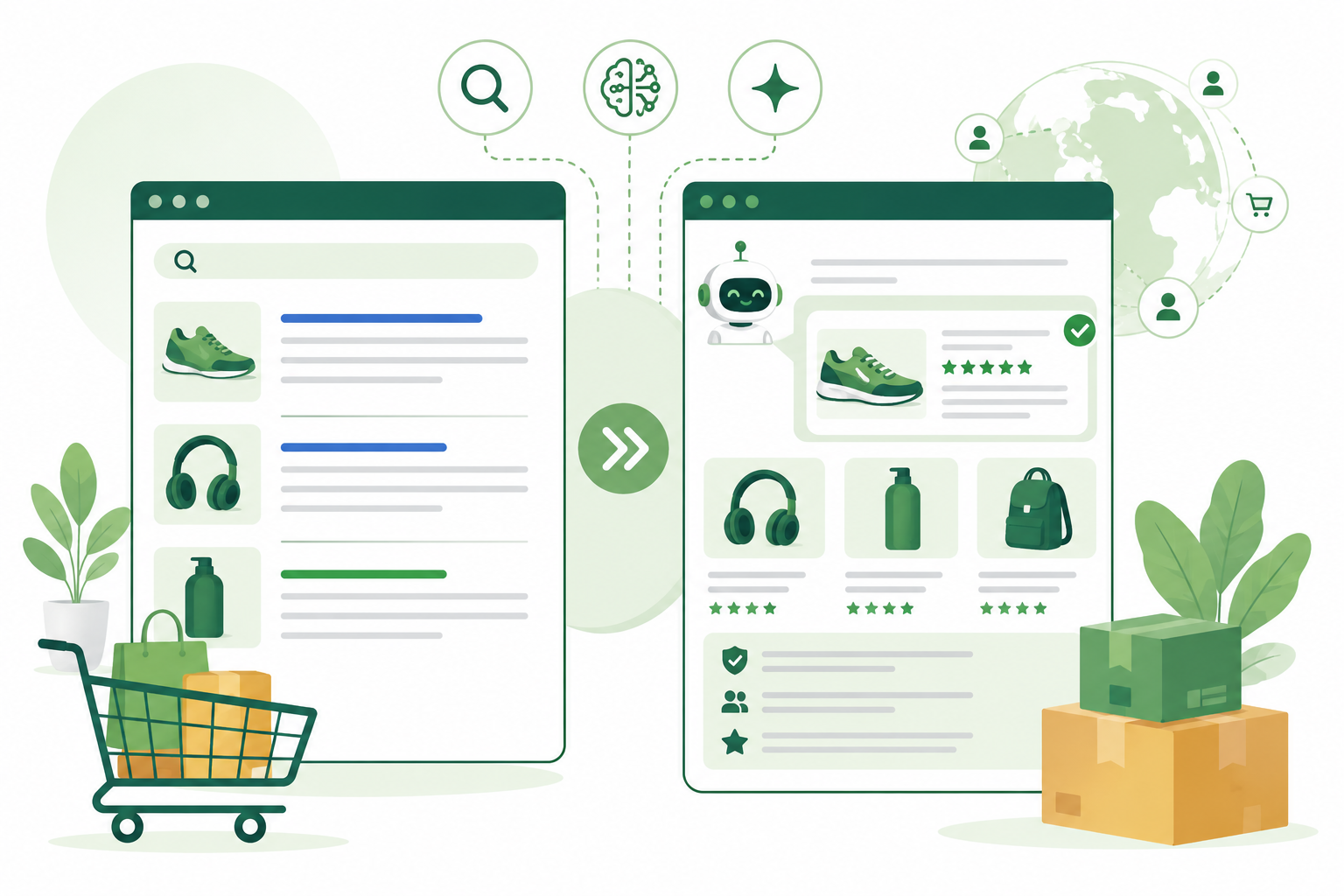
If you've noticed your ecommerce traffic behaving differently lately, you're not imagining it. Search results now come wrapped in AI-generated summaries, and shoppers increasingly ask ChatGPT or Google AI Overview for buying advice.
For a store still optimising purely for the old search results page, that's a real gap. Here's what's actually changed, and what every ecommerce brand still needs to get right regardless.
TL;DR
- Traditional SEO gets your product and category pages to rank in search results. AI search optimisation (GEO/AEO) gets your brand mentioned inside AI-generated answers on Google AI Overviews, ChatGPT, and Perplexity.
- These aren't competing strategies. AI search tools still depend on the same crawlable, well-structured, indexed web that traditional SEO has always built. Weak fundamentals mean zero AI visibility too.
- Google AI Overviews are now live in more than 200 countries and territories and over 40 languages, reaching billions of searches a month, according to Google.
- ChatGPT alone now has over 900 million weekly active users worldwide, which shows why AI platforms can no longer be treated as a side channel.
- The practical shift: fewer clicks, more citations. Success today is measured by whether you're mentioned, not just whether you rank.
What Is Traditional eCommerce SEO?
Traditional eCommerce SEO is the process of optimizing your online store, its product pages, category pages, and overall site architecture, so search engines can find, understand, and rank it well against a specific search query. Unlike SEO for a blog or brochure site, it also has to account for large product catalogues, filtered navigation, and constantly changing inventory and pricing.
It rests on a few core levers:
Keyword research and targeting: using the terms your customers actually search, across product titles, category pages, and meta descriptions
Technical SEO: site speed, mobile responsiveness, crawlability, and clean URL structures
On-page optimisation: clear headings, internal linking, and unique (not duplicated) product descriptions
Backlink authority: earning links and mentions from other credible websites
Structured data: Product, Offer, and Review schema that helps Google display rich results like star ratings and pricing
None of this is going away. It's still the entry ticket for search engines and for AI systems alike.
What Is AI Search Optimisation (GEO/AEO)?
AI search optimisation is the practice of structuring your content so AI systems can accurately extract, summarise, and cite it inside a generated answer, rather than simply ranking it.
For an ecommerce brand, that means making sure product data, specifications, pricing, and reviews are structured clearly enough that an AI system can confidently recommend your product over a competitor's, not just describe it.
This work usually falls under two related terms:
Generative Engine Optimisation (GEO)
making sure your content is clear, factual, and easy for an AI model to lift accurately into a summary
Answer Engine Optimisation (AEO)
writing direct, structured answers to specific buyer questions, so that AI platforms can quote you with confidence
What it focuses on:
- Clean entity consistency: your brand name, product specs, and pricing stated identically everywhere online
- FAQ, Product, and Review schema that gives AI platforms an unambiguous, machine-readable source
- Direct-answer content: leading with the answer in the first two or three sentences, not burying it under marketing copy
- Third-party credibility: reviews, comparison articles, and press mentions that AI systems use to judge trustworthiness
Traditional SEO vs AI Search Optimisation
Swipe horizontally to see the full table →
| Aspect | Traditional SEO | AI Search Optimisation |
|---|---|---|
| Goal | Rank on the search results page | Get cited inside an AI-generated answer |
| Success metric | Rankings, clicks, organic traffic | Citations, brand mentions, AI-referred visits |
| Content style | Comprehensive, keyword-driven | Short, direct, structured, buyer-question-first |
| Authority signal | Backlinks to your domain | Consistent facts and mentions across the whole web |
| Primary tools | Rank trackers, Search Console, Ahrefs/SEMrush | AI visibility trackers, schema validators, manual prompt testing |
| Speed of change | Slow, algorithm updates take months | Faster, AI answers can shift in 30 to 60 days |
What's Actually Changed for eCommerce Sites
The impact on clicks is measurable, not just anecdotal. A large-scale Ahrefs study analysing hundreds of thousands of keywords found that Google's AI Overviews now result in a 58% lower average click-through rate for top-ranking pages, up from a 34.5% drop recorded just eight months earlier, per Ahrefs' research. That's a meaningful chunk of "invisible" traffic for any store that only optimises for the classic search results page.
Here's the shift in practical terms:
From ranking position to being quoted. A product page can hold the #1 spot and still be missing entirely from the AI Overview sitting above it.
From keyword density to answer clarity. Padding a page with keyword variations does nothing for an AI model checking whether your answer is accurate and trustworthy.
From domain-only backlinks to whole-web reputation. AI tools form an opinion of your brand from reviews, comparison articles, and forum mentions, not just links pointing at your site.
From Google-only to a multi-platform race. Google AI Overviews remain the biggest surface by volume, but ChatGPT, with over 900 million weekly active users worldwide, and Perplexity are steadily gaining ground as product research tools in their own right.
Why the Two Are Interdependent, Not Competing
Here's the part most comparisons gloss over: AI search tools cannot cite what they can't crawl, index, or trust.
If your site has poor technical health, thin content, or inconsistent product data, no amount of clever schema markup will get you cited. The AI system simply has nothing solid to work with. Traditional SEO builds the foundation. AI search optimisation is the layer built on top of it, not a replacement for it.
Think of it this way:
A Quick Real-World Example
Picture a D2C skincare brand selling face serums online. Under a traditional SEO approach, they'd target keywords like "vitamin C serum for oily skin" and build category pages around them, backed by backlinks from beauty blogs. That alone might get them ranking on page one, but it doesn't guarantee they show up when someone asks an AI tool for a recommendation.
Layering in AI search optimisation, they'd also:
- Add Product and FAQ schema answering real buyer questions like "does vitamin C serum work in humid climates"
- Keep pricing, ingredients, and availability identical across their website, marketplace listings, and social profiles
- Earn genuine third-party reviews and comparison mentions that AI tools can draw on
The difference shows up the moment someone asks ChatGPT or Google AI Mode "best vitamin C serum for humid weather." With the AI-search layer in place, this brand has a real shot at being named directly in the answer, not just ranking on page one where an AI Overview might push it below the fold anyway.
How to Optimise Your eCommerce Store for Both
Audit entity consistency first. Make sure brand name, specs, and pricing match across your site, marketplace listings, and review platforms.
Rewrite key product and category pages around real buyer questions. Answer directly in the first few sentences, then expand.
Expand schema markup. Product, Offer, Review, and FAQ schema on every page where it genuinely applies.
Build genuine third-party coverage. Reviews and comparison mentions carry real weight for AI citation.
Check AI crawler access. Make sure your robots.txt isn't accidentally blocking AI search bots you actually want indexing you.
Test manually. Ask ChatGPT, Perplexity, and Google AI Mode the questions your buyers ask, and track where you show up, or don't.
New Metrics to Track Success
Swipe horizontally to see the full table →
| Traditional metric | Still matters? | New AI-era metric to add |
|---|---|---|
| Keyword rankings | Yes | AI Overview / AI Mode citations |
| Organic click-through rate | Yes | Brand mentions inside AI answers |
| Backlink count | Yes | Entity recognition across the web |
| Organic sessions | Yes | AI-referred traffic and assisted conversions |
Common Pitfall: Treating AI SEO as a Shortcut
A word of caution: chasing AI citations with thin, unverified, or inconsistent content usually backfires. AI systems are evaluating trustworthiness, not just structure. Publishing rushed FAQ pages stuffed with schema, but no real substance, won't earn you a mention. The brands that win are the ones treating this as an extension of solid SEO work, not a workaround.
Conclusion
Traditional SEO and AI search optimisation aren't rival strategies; they're two layers of the same visibility problem. One gets your store found. The other gets it recommended. As Google AI Overviews and platforms like ChatGPT and Perplexity keep growing their reach, the smartest move isn't choosing one over the other. It's making sure your technical and content foundation is strong enough to support both.
Let's Build That Foundation Together
From technical SEO to AI-ready content and schema, we'll help you show up wherever your customers are searching, on Google or inside an AI answer.
Get Your Free SEO + AI Visibility Audit