
How to Optimize Shopify Product Pages for AI Search
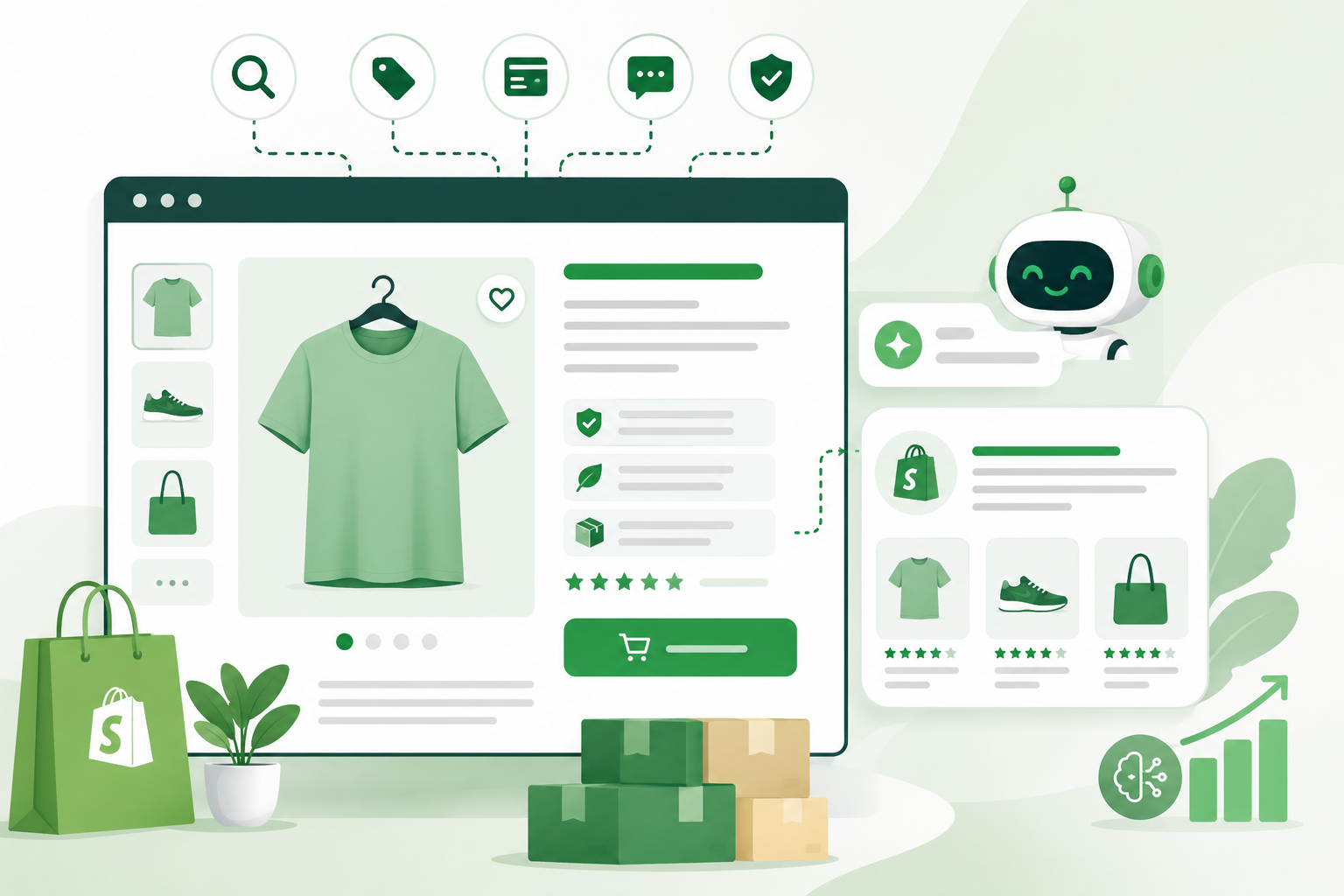
AI-powered search is reshaping eCommerce discovery at a rapid pace. Today, customers are no longer relying only on Google search results; instead, they are asking AI tools like ChatGPT, Google AI Overviews, Gemini, Claude, Perplexity, and Microsoft Copilot for personalized product recommendations and buying advice.
This shift means Shopify store owners must optimize product pages not only for traditional SEO but also for AI Search Optimization, Answer Engine Optimization (AEO), Generative Engine Optimization (GEO), and Large Language Model (LLM) understanding.
This guide explains how to transform your Shopify product pages into AI-friendly, high-converting assets that can be discovered, understood, and recommended by modern AI systems.
What is AI Search Optimization for Shopify?
AI Search Optimization is the process of structuring your Shopify product pages so that AI systems can easily interpret, trust, and recommend them in conversational search results.
Unlike traditional SEO, which focuses mainly on keywords and backlinks, AI search optimization focuses on meaning, context, trust, and entity recognition.
Improve your product understanding for AI systems by writing detailed, human-like descriptions that clearly explain what your product does, who it is for, and what problems it solves in real-world usage scenarios.
Strengthen semantic relevance across your Shopify store by connecting product pages, collections, and blogs in a way that helps AI models understand your store as a structured knowledge system rather than isolated pages.
Build entity-level brand recognition so that AI systems identify your business as a trusted source in your niche rather than just a transactional online store.
Why AI Search Matters for Shopify Stores
Consumer behavior has shifted from keyword-based searches to conversational queries. Users now expect direct answers instead of browsing multiple links.
AI search increases purchase intent traffic because users asking detailed questions through AI tools are usually closer to making a buying decision compared to traditional search users.
AI-generated recommendations reduce competition visibility because instead of showing 10–20 search results, AI platforms often recommend only a few trusted brands or products.
Strong AI optimization improves conversion rates because users arriving from AI recommendations already trust the suggested products, leading to higher engagement and sales.
Create Unique and Helpful Product Descriptions
One of the most important ranking factors for AI search is originality and clarity in product descriptions.
Write product descriptions in natural language format that explain the product's purpose, benefits, and real-life usage scenarios instead of simply listing technical specifications or copying manufacturer content.
Focus on solving customer problems clearly by explaining how the product improves daily life, enhances productivity, or provides convenience in a way AI systems can easily interpret.
Avoid duplicate content across product pages because AI models prioritize unique, high-value content when deciding which products to recommend in search responses.
Add Comprehensive Product Information
AI systems prefer pages that answer all possible user questions in one place.
Include detailed product specifications and usage details so customers and AI systems can fully understand the product's size, material, compatibility, and performance characteristics without needing external sources.
Add clearly structured sections for features and benefits that separate what the product does from how it improves the customer's experience in practical scenarios.
Provide complete shipping, return, and warranty information to build trust and reduce friction in purchase decisions while increasing AI confidence in recommending your product.
Optimize Product FAQs for AI Search
FAQs play a critical role in Answer Engine Optimization because AI systems often extract direct answers from them.
Create question-based FAQ sections that reflect real customer intent such as "Is this product waterproof?" or "How long does delivery take?" so AI models can directly use these answers in recommendations.
Provide clear and concise answers in natural language format that avoid unnecessary complexity while still being informative and helpful for both users and AI systems.
Update FAQs regularly based on customer queries and feedback to ensure your content stays relevant, accurate, and aligned with evolving search behavior patterns.
Implement Structured Data for AI Understanding
Structured data helps AI systems interpret your product pages more accurately by providing machine-readable context.
Use Product Schema to define product identity clearly including name, price, availability, SKU, and brand so AI systems can confidently categorize your offerings.
Add Review and Rating Schema to enhance trust signals by helping AI understand real customer sentiment and product performance metrics.
Implement FAQ Schema to improve visibility in AI-generated answers so your responses can appear directly in conversational search results and voice queries.
Optimize Images for AI and Visual Search
AI search is increasingly multimodal, meaning it processes text, images, and context together.
Use descriptive and keyword-rich image file names that clearly explain what the image represents instead of using generic filenames like IMG001.jpg.
Add meaningful alt text that describes product usage and appearance so AI systems and accessibility tools can understand visual context accurately.
Include multiple high-quality product images from different angles to help both users and AI systems build a complete understanding of the product.
Build Trust with Customer Reviews and Social Proof
Trust signals strongly influence AI recommendations because AI models prioritize credible and verified sources.
Encourage customers to write detailed reviews with real experiences because longer, descriptive reviews provide richer data for AI systems to analyze product satisfaction.
Display verified ratings and reviews prominently on product pages so both users and AI systems can quickly assess product quality and reliability.
Include user-generated photos and videos whenever possible to increase authenticity and improve engagement signals across your Shopify store.
Strengthen Internal Linking Structure
Internal linking helps AI understand relationships between different pages on your Shopify store.
Link product pages to relevant category pages and related products so AI systems can understand how your catalog is structured and interconnected.
Connect products with blog content and buying guides to increase topical authority and help AI systems associate your store with expertise in your niche.
Use descriptive anchor text for internal links so AI models can better understand the context and relevance of linked pages.
Improve Technical SEO for AI Readiness
Technical performance remains a foundation for AI search visibility.
Ensure fast loading speed across all Shopify product pages by optimizing images, reducing scripts, and using efficient themes that improve user experience and crawlability.
Maintain mobile responsiveness for all devices because most AI-assisted searches occur on mobile platforms where usability is a key ranking factor.
Implement HTTPS security and clean URL structures to build trust and ensure that AI systems consider your site reliable and safe for users.
Strengthen Semantic SEO and Topic Authority
AI systems understand meaning and context rather than just keywords.
Use related semantic keywords naturally within product descriptions such as synonyms, use cases, and alternative product names to help AI understand broader relevance.
Create content clusters around your main product categories to establish authority in your niche and improve AI recognition of your expertise.
Develop educational content that supports your products such as buying guides, comparisons, and tutorials that reinforce your brand authority.
Build Strong E-E-A-T Signals
Google's E-E-A-T framework is essential for AI-driven search visibility.
Showcase real-world experience and expertise through content creation so AI systems recognize your brand as a knowledgeable source in your industry.
Highlight brand authority through certifications, awards, and industry recognition to increase trust signals across both search engines and AI platforms.
Maintain transparency in business information and policies to ensure users and AI systems view your store as credible and reliable.
Avoid Common AI SEO Mistakes
Many Shopify stores fail to optimize effectively for AI search due to avoidable errors.
Avoid using duplicate manufacturer descriptions across multiple products because this reduces originality and weakens AI ranking signals.
Do not ignore structured data implementation on product pages as it limits AI's ability to understand your content accurately.
Avoid publishing thin or low-value content that lacks depth and context because AI systems prioritize comprehensive and helpful information.
How to Measure AI Search Performance
Tracking AI SEO success requires a combination of traditional and modern metrics.
Monitor branded search growth to measure increasing brand awareness as more users begin searching for your store directly.
Track engagement metrics such as time on page and bounce rate to evaluate how effectively your product pages retain user attention.
Analyze conversion rates from organic and referral traffic sources to understand how AI-driven discovery impacts actual sales performance.
Conclusion
Optimizing Shopify product pages for AI search requires a shift from keyword-focused SEO to intent-driven, structured, and trust-based content creation. By combining AEO, GEO, LLM optimization, and traditional SEO strategies, Shopify store owners can significantly improve their visibility in both search engines and AI-powered platforms.
The future of eCommerce belongs to brands that are not only searchable but also recommendable. Stores that invest in structured data, semantic content, trust signals, and high-quality product experiences will be the ones AI systems consistently suggest to users.
Start optimizing your Shopify product pages today to ensure your brand becomes a trusted recommendation in the next generation of AI-driven search.
FAQs
1. What is AI Search Optimization for Shopify product pages?
AI Search Optimization for Shopify product pages is the process of structuring content so AI tools like Google AI Overviews, ChatGPT, and Gemini can understand, rank, and recommend products in conversational search results.
2. Why is AI search important for eCommerce brands?
AI search is important because it directly recommends a small number of trusted products to users, increasing visibility, purchase intent traffic, and conversion rates for optimized Shopify stores.
3. How do AI tools choose which Shopify products to recommend?
AI tools choose products based on relevance, content quality, structured data, customer reviews, brand authority, and how clearly the product solves user intent and real-world problems.
4. How can I optimize Shopify product descriptions for AI search?
You can optimize product descriptions by writing original, natural-language content that explains product benefits, use cases, and problem-solving value instead of copying manufacturer descriptions.
5. What is the role of structured data in AI SEO?
Structured data helps AI systems understand product details like price, availability, ratings, and brand in a machine-readable format, improving visibility in AI-generated answers and rich results.
6. Why are FAQs important for AI Search Optimization (AEO)?
FAQs are important because AI systems extract direct answers from them, making it easier for Shopify product pages to appear in voice search and AI-generated responses.
7. How do customer reviews impact AI search rankings?
Customer reviews improve AI rankings by providing trust signals, real user experiences, and sentiment data that help AI systems evaluate product quality and reliability.
8. What is semantic SEO in AI search optimization?
Semantic SEO is the practice of using related terms, context, and meaning-based content so AI systems can understand topics deeply instead of relying only on exact keywords.
9. How does internal linking help AI SEO?
Internal linking helps AI systems understand relationships between product pages, collections, and blogs, improving topical authority and content discoverability.
10. What is the biggest benefit of AI Search Optimization for Shopify stores?
The biggest benefit of AI Search Optimization is increased visibility in AI-generated recommendations, which leads to higher trust, stronger traffic quality, and improved sales conversions.