
What Is AI SEO and How Does It Impact Search Rankings?
Search engine optimization is no longer limited to keywords, backlinks, and traditional Google rankings. With the rise of AI-powered search, Google AI Overviews, ChatGPT, Gemini, Perplexity, voice search, and other generative AI platforms, businesses now need a smarter approach to online visibility. This is where AI SEO becomes important.
AI SEO, also known as artificial intelligence SEO or AI search optimization, is the process of improving website content, technical structure, topical authority, and brand credibility so that search engines and AI systems can understand, summarize, and recommend your business.
Unlike traditional SEO, which mainly focuses on ranking web pages, AI SEO helps improve visibility across AI-driven search results, conversational searches, featured snippets, zero-click searches, and modern AI search experiences. It combines semantic SEO, entity-based SEO, AI content optimization, structured data SEO, and E-E-A-T SEO to help websites stay competitive in changing search rankings.
For businesses that want to improve organic search visibility and future-proof their digital presence, AI SEO is becoming an essential part of a modern SEO strategy.
What Is AI SEO?
AI SEO means optimizing your website for both search engines and AI-powered platforms. It helps your content become easier to understand, easier to index, and easier to recommend in search results.
In traditional SEO, the main goal is to rank higher on search engine result pages. In AI SEO, the goal is broader. Your content should be strong enough to appear in normal rankings, AI-generated answers, Google AI Overviews, voice search results, and conversational search platforms.
For example, when a user searches “best SEO agency for ecommerce business,” Google may show regular search results. But in an AI-powered search experience, the user may get a summarized answer explaining what type of agency to choose, what services matter, and which factors to compare.
If your website has clear content, strong topical authority, structured data, useful FAQs, and trusted brand signals, your chances of being understood and recommended by AI search systems may improve.
Why AI SEO Matters in Modern Search
Search behavior has changed. Users are not only typing short keywords anymore. They are asking complete questions, comparing services, and expecting direct answers.
Earlier, someone may have searched:
Now, users may search:
“Which SEO agency can help my business appear in Google AI Overviews?”
“How can AI SEO services improve search rankings?”
“What is the difference between traditional SEO and AI search optimization?”
“How does AI content optimization help ecommerce websites?”
This shift has made search intent optimization more important than ever. Your content must not only include keywords but also answer the real questions behind those keywords.
AI-powered search systems understand context, meaning, entities, and relationships between topics. This means businesses need content that is clear, detailed, trustworthy, and semantically rich.
How AI SEO Is Different from Traditional SEO
Traditional SEO and AI SEO are closely connected, but they are not the same.
Traditional SEO focuses on:
- Keyword research
- Meta titles and descriptions
- Backlinks
- Technical SEO
- Page speed
- Mobile usability
- Internal linking
- Content optimization
AI SEO includes all of these, but it also focuses on deeper search understanding. It helps AI-powered search platforms understand your content better through:
- Semantic SEO
- Entity-based SEO
- Topical authority
- Structured data SEO
- Schema markup
- Conversational search optimization
- E-E-A-T signals
- Brand mentions
- AI content optimization
- Clear answer formatting
For example, a traditional SEO page targeting “local SEO services” may only include the keyword in headings and paragraphs. But an AI SEO-optimized page will also answer related questions like:
What are local SEO services?
Who needs local SEO?
How does local SEO improve local rankings?
How much do local SEO services cost?
What should a business look for in a local SEO company?
This type of content helps search engines and AI systems understand the complete topic, not just the target keyword.
How AI SEO Impacts Search Rankings
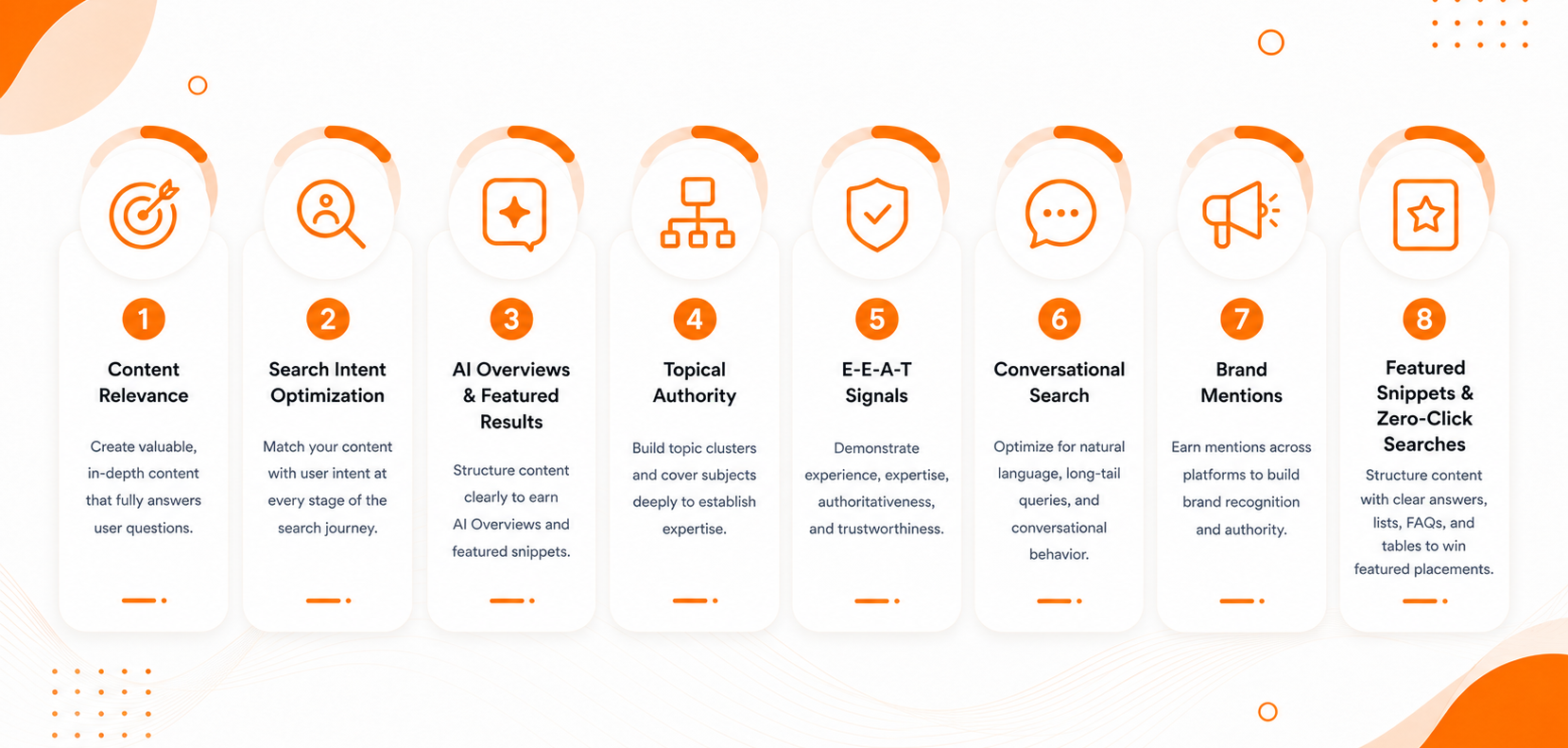
AI SEO can impact search rankings in many important ways. It improves how search engines understand your website, how users engage with your content, and how AI platforms interpret your brand authority.
1. AI SEO Improves Content Relevance
Search engines are now better at understanding meaning. They do not simply match keywords. They analyze the user’s intent, content depth, page quality, and topic coverage.
This is why keyword stuffing no longer works. A page that repeats “AI SEO” many times without useful information will not perform well. Instead, the content should explain the topic clearly and naturally.
For example, a strong page about AI SEO services should explain:
- What AI SEO means
- How AI search optimization works
- Why AI-powered search matters
- How Google AI Overviews affect visibility
- What role semantic SEO plays
- Why structured data and schema markup are useful
- How businesses can improve AI search rankings
When your content covers the topic properly, search engines can better understand its relevance.
2. AI SEO Helps You Target Search Intent
One of the biggest advantages of AI SEO is better search intent optimization. Search intent means the real reason behind a user’s query.
A person searching “what is AI SEO” wants information.
A person searching “AI SEO services” may be looking for an agency.
A person searching “best AI SEO agency” may be ready to compare service providers.
A person searching “AI SEO pricing” may be close to making a decision.
Your content should match the user’s stage in the search journey.
➟ For informational queries, provide educational content.
➟ For commercial queries, explain your services, process, benefits, and trust factors.
➟ For comparison queries, provide clear and honest differences.
➟ For conversion queries, include a strong call to action.
This approach helps improve user experience and search visibility.
3. AI SEO Supports Google AI Overviews
Google AI Overviews are changing how users interact with search results. Instead of only seeing a list of links, users may see AI-generated summaries at the top of the search page.
This makes content structure very important.
To improve your chances of appearing in AI Overviews or AI-generated search results, your content should include:
- Clear definitions
- Direct answers
- Short paragraphs
- Helpful subheadings
- FAQs
- Original examples
- Step-by-step explanations
- Authoritative information
- Schema markup where relevant
For example, instead of writing a vague paragraph about AI SEO, you can include a direct answer like:
“AI SEO is the process of optimizing website content, structure, and authority so that search engines and AI platforms can understand, summarize, and recommend your content in traditional and AI-powered search results.”
This type of clear answer is easier for AI systems to process.
4. AI SEO Builds Topical Authority
Topical authority means your website is trusted for a particular subject area. If your website covers a topic deeply across multiple pages, search engines are more likely to understand your expertise.
For example, an SEO agency website should not have only one page about SEO. It should build a strong content cluster around related topics such as:
- AI SEO services
- Technical SEO
- Local SEO
- Ecommerce SEO
- Enterprise SEO
- B2B SEO
- Content marketing
- Schema markup
- Search intent optimization
- SEO audits
- Google algorithm updates
- Case studies
When these pages are connected through internal links, they help search engines understand your website structure and expertise.
This also supports AI search visibility because AI systems often look for sources that provide complete and reliable topic coverage.
5. AI SEO Strengthens E-E-A-T Signals
E-E-A-T stands for Experience, Expertise, Authoritativeness, and Trustworthiness. These signals are important because users and search engines both want reliable information.
AI SEO helps improve E-E-A-T SEO by making your experience and credibility more visible.
You can strengthen E-E-A-T by adding:
- Author details
- Company background
- Years of experience
- Case studies
- Client testimonials
- Real examples
- Service process
- Transparent pricing or consultation details
- Updated content
- Trust signals and reviews
For example, if your agency has 13+ years of experience in SEO and digital marketing, mention it naturally on your website. This helps users understand your credibility and gives search engines better context about your expertise.
6. AI SEO Improves Visibility for Conversational Search
Search is becoming more conversational. People are asking longer questions instead of typing short phrases.
Examples include:
“How can AI SEO help my business rank better?”
“Is AI SEO different from normal SEO?”
“Can AI SEO services help my website appear in ChatGPT or Gemini?”
“What should I include in an AI SEO strategy?”
This is why conversational search optimization is now important.
To optimize for conversational search, write in a natural tone, include FAQs, answer specific questions, and avoid overly complicated language. Your content should sound helpful, not robotic.
This also improves readability, which can increase engagement and reduce bounce rate.
7. AI SEO Increases the Importance of Brand Mentions
Backlinks are still important, but brand mentions are becoming more valuable in AI-powered search. AI systems try to understand which brands are trusted, frequently mentioned, and connected to specific services or topics.
A brand mention is when your business name appears on another website, social platform, directory, review site, article, or industry page, even if there is no clickable backlink.
For example, if your brand is mentioned in:
- Client reviews
- Business directories
- Case studies
- Guest blogs
- Industry articles
- Social media discussions
- Press releases
- Podcast descriptions
…it can help improve brand authority and recognition.
For AI-driven search results, brand mentions can support entity-based SEO by helping AI systems connect your brand with your services, location, expertise, and industry.
8. AI SEO Helps with Featured Snippets and Zero-Click Searches
Featured snippets and zero-click searches are also important parts of modern SEO. In a zero-click search, the user gets the answer directly on the search results page without clicking a website.
This may sound like a disadvantage, but it can still improve brand visibility if your content is selected as a trusted source.
To optimize for featured snippets and zero-click searches, include:
- Short definitions
- Numbered steps
- Comparison tables
- Bullet points
- FAQ answers
- Clear headings
- Simple explanations
For example, if your blog answers “What is AI SEO?” clearly in the first few lines, it has a better chance of being used in a featured result or AI-generated summary.
Key AI SEO Strategies for Better Search Rankings
To improve your website’s performance in traditional search and AI-powered search, you need a balanced strategy. Here are the most important AI SEO strategies.
1. Create Helpful and People-First Content
Your content should solve real user problems. Avoid writing only for search engines. Focus on clarity, usefulness, and trust.
A good AI SEO blog should include:
- Clear explanations
- Practical examples
- Updated information
- Relevant keywords
- User-focused answers
- Natural language
- Strong formatting
The goal is to help the user first. Search visibility comes from usefulness.
2. Use Semantic SEO Naturally
Semantic SEO means covering related words, meanings, and concepts around your main topic.
For example, if your main keyword is “AI SEO,” your content can naturally include semantic keywords such as:
- AI search optimization
- AI-powered search
- Generative AI search
- Google AI Overviews
- AI search rankings
- Entity-based SEO
- AI content optimization
- Topical authority
- Structured data SEO
- Schema markup
- Organic search visibility
This helps search engines understand the full meaning of your content.
3. Optimize for Entities, Not Just Keywords
Entity-based SEO focuses on people, places, brands, services, products, and concepts. Search engines and AI systems use entities to understand relationships.
For example, if your website talks about AI SEO, related entities may include:
- Google Search
- Google AI Overviews
- ChatGPT
- Gemini
- Perplexity
- Schema markup
- E-E-A-T
- Search intent
- Digital marketing
- Content optimization
When these entities are used naturally, your content becomes more meaningful and easier to understand.
4. Add Structured Data and Schema Markup
Structured data SEO helps search engines understand your content more clearly. Schema markup can improve how your pages appear in search results.
Useful schema types include:
- Article schema
- FAQ schema
- Local Business schema
- Organization schema
- Review schema
- Service schema
- Product schema
For an AI SEO services page, Service schema, Organization schema, FAQ schema, and Review schema can be useful.
5. Build Strong Topic Clusters
A topic cluster is a group of related pages connected through internal links. It helps build topical authority.
For example, if your main service page is “AI SEO Services,” supporting blogs can include:
What Is AI SEO?
AI SEO vs Traditional SEO
How Google AI Overviews Affect SEO
Best AI SEO Strategies for Businesses
How Schema Markup Helps AI Search
Why Brand Mentions Matter in AI SEO
This creates a strong content ecosystem around your main service.
6. Improve Technical SEO
AI SEO cannot work properly if your website has technical issues. Your site should be easy to crawl, fast to load, mobile-friendly, and properly indexed.
Important technical SEO areas include:
- Page speed
- Core Web Vitals
- Mobile responsiveness
- Clean URL structure
- XML sitemap
- Robots.txt
- Canonical tags
- Internal linking
- Indexing control
- HTTPS security
A technically strong website helps both search engines and AI systems access and understand your content.
7. Keep Content Updated
AI search systems prefer fresh and accurate information, especially in fast-changing industries like SEO, digital marketing, technology, finance, and healthcare.
You should regularly update your content with:
- New examples
- Latest trends
- Updated FAQs
- Recent platform changes
- Improved statistics
- Better internal links
- Fresh service information
Updated content builds trust and improves long-term organic search visibility.
Does AI SEO Replace Traditional SEO?
No, AI SEO does not replace traditional SEO. It improves and expands it.
Traditional SEO is still the foundation of search rankings. Your website still needs keyword research, technical SEO, backlinks, internal linking, high-quality content, and strong user experience.
AI SEO adds another layer by preparing your website for AI-powered search, Google AI Overviews, conversational search, voice search, and AI-driven discovery platforms.
In simple terms:
Traditional SEO helps your website rank.
AI SEO helps your website get understood, trusted, summarized, and recommended.
Both are necessary for a strong modern SEO strategy.
Final Thoughts
AI SEO is becoming one of the most important parts of modern search engine optimization. As Google and other platforms continue to use artificial intelligence in search results, businesses need to adapt their SEO strategies.
Ranking today is not only about using the right keywords. It is also about answering user questions clearly, building topical authority, improving E-E-A-T signals, using structured data, earning brand mentions, and creating content that AI-powered search systems can understand.
Businesses that invest in AI SEO early can improve their chances of appearing in traditional search results, Google AI Overviews, featured snippets, voice search, and conversational AI platforms.
For long-term digital growth, AI SEO is no longer optional. It is an essential strategy for improving search rankings, increasing organic search visibility, and staying competitive in the future of search.